Suggestions
Share
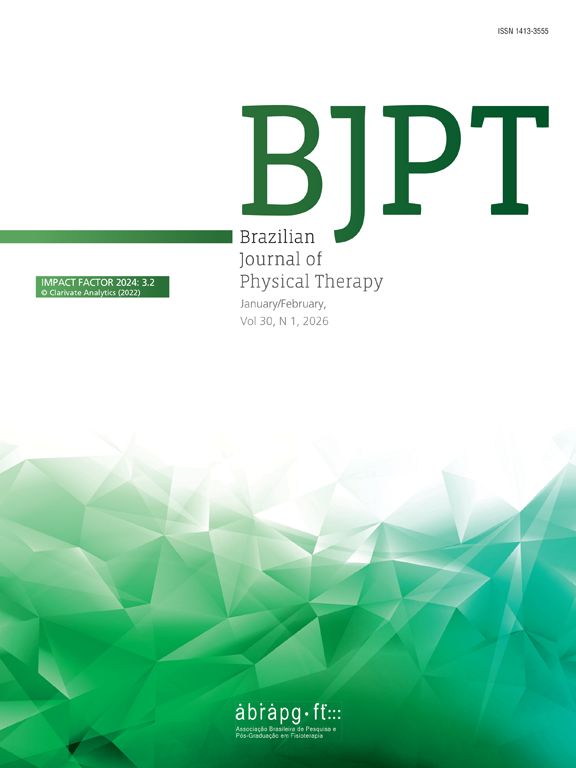
Brazilian Journal of Physical Therapy
ISSN: 1413-3555

The Brazilian Journal of Physical Therapy (BJPT) is the official publication of the Brazilian Society of Physical Therapy Research and Graduate Studies (ABRAPG-Ft). It publishes original research articles on topics related to the areas of physical therapy and rehabilitation sciences, including clinical, basic or applied studies on the assessment, prevention, and treatment of movement disorders.

See more

Indexed in:

Scopus, Medline, PubMed Central (PMC), SCImago Journal Rank (SJR), SNIP

See more

Follow us:

Impact factor

The Impact Factor measures the average number of citations received in a particular year by papers published in the journal during the two preceding years.

© Clarivate Analytics, Journal Citation Reports 2025

See more
Impact factor 2024
3.2
Citescore

CiteScore measures average citations received per document published.

See more
Citescore 2024
6.1
SJR

SRJ is a prestige metric based on the idea that not all citations are the same. SJR uses a similar algorithm as the Google page rank; it provides a quantitative and qualitative measure of the journal's impact.

See more
SJR 2024
0.952
SNIP

SNIP measures contextual citation impact by wighting citations based on the total number of citations in a subject field.

See more
SNIP 2024
1.568
View more metrics
Hide
Last published articles
Original Research
Foot-specific exercise intervention for forefoot deformity in individuals with type 2 diabetes and peripheral neuropathy: A randomized controlled clinical trial with 3-year follow-up
JA Zellers, K Steger-May, PK Commean, H-J Jeong, EM Bullard, MJ Mueller, MK Hastings
Braz J Phys Ther. 2026;30:101563
Highlights

  • Diabetic peripheral neuropathy can lead to forefoot deformity.

  • A foot-specific intervention did not mitigate forefoot deformity.

  • 26 % of participants had progression of forefoot deformity.

  • Change in bone mineral density predicted forefoot deformity progression.

Full text access
Open Article
Original Research
Assessing postural control deficits with the Balance Evaluation Systems test for children, second edition in children with Developmental Coordination Disorder
Maja Van Grinderbeek, Katrijn Klingels, Mieke Goetschalckx, Charlotte Johnson, Silke Velghe, Ann Hallemans, Evi Verbecque
Braz J Phys Ther. 2026;30:101558
Highlights

  • The Kids-BESTest-2 can help specify postural control problems.

  • Age and MABC-2 total and balance scores predict performance on the Kids-BESTest-2.

  • The prediction formula helps clinicians decide to administer the Kids-BESTest-2.

Full text access
Original Research
Assessing postural balance for predicting falls in individuals with Chronic obstructive pulmonary disease: A prospective cohort study
Bárbara Aparecida Teodoro Alcantara Verri, Caroline Maschio de Censo, Juliana de Melo Batista dos Santos, Rafaella Fagundes Xavier, João Marcos Salge, Regina Maria Carvalho-Pinto, Celso Ricardo Fernandes Carvalho
Braz J Phys Ther. 2026;30:101557
Highlights

  • Individuals with COPD have a higher fall risk, but studies predicting falls are scarce.

  • Falls were associated with greater center of pressure displacement post-effort.

  • The more challenging the assessed postural balance, the better the prediction.

  • Mini-BESTest scores did not reflect fall history in moderate-to-severe COPD.

  • Challenging balance tests seem to better identify fall risk in severe COPD.

Full text access
Systematic Review
Effectiveness of exercise interventions to improve motor coordination and manual dexterity of deaf children: A systematic review and meta-analysis of randomized controlled trials
Renato S. Melo, Ilana Santos de Oliveira, Cleysiane de Araújo Oliveira, Alexandre Delgado, Karla Mônica Ferraz, Rosalie Barreto Belian
Braz J Phys Ther. 2026;30:101556
Highlights

  • This is the first systematic review on the topic.

  • These exercises seem to be promising to improve motor skills rehabilitation of deaf children.

  • Low-certainty evidence supports the use of these exercises to rehabilitate deaf children.

  • This review provides implications for clinical practice and future trials on the topic.

Full text access
Latest issue
Issue
portada-S1413355525X00095Vol. 30. Issue 2. (In progress)
(1 March 2026)
This issue is in progress but contains articles that are final and fully citable.
Systematic Review
Comparing the effects of different physical therapy modalities with physical exercise in improving the walking function of patients with peripheral vascular disease: A Network Meta-analysis
Guan-Cheng Zhu, Jun-Hui Ong, Ching-Hsia Hung
Braz J Phys Ther. 2026;30:101562
Highlights

  • It is unclear which physical therapy modality works best for patients with PVD.

  • Extracorporeal shockwave therapy is effective in managing PVD on its own.

  • Hydrotherapy combined with exercise was also effective in managing PVD.

Full text access
Original Research
Independent risk factors associated with a history of exercise associated muscle cramps (EAMC) among 21460 cycling race entrants (SAFER XXXVI): a descriptive cross-sectional study
Carey Pohl, Martin Schwellnus, Nicola Sewry, Pieter Boer, Esme Jordaan, Carel Viljoen
Braz J Phys Ther. 2026;30:101559
Highlights

  • Older cyclists and males have a significantly higher lifetime prevalence of hEAMC.

  • EAMC in cyclists affects mainly the quadriceps muscles.

  • EAMC in cyclists occurs mainly in the 4th quarter during a race.

  • Risk factors for hEAMC: experience, chronic disease, allergies, medications, past injury.

Full text access
Open Article
Type of health locus of control predicting pain, function, and global perceived effect in patients with chronic low back pain receiving active versus passive interventions: an observational study
Ivan de Araujo Barros, Arthur de Sá Ferreira, Thaís de Souza Horsth, Thamires de Jesus Holmes, Anna Amalheiro dos Santos, Luciana Crepaldi Lunkes
Braz J Phys Ther. 2026;30:101560
Highlights

  • The majority of the sample had an internal locus of control.

  • There was no significant change in the locus at baseline and endpoint of observation.

  • Locus, treatment, and interaction between them are not predictors of pain and functional ability.

  • The locus did not influence the global perceived effect.

Full text access
Blockade of opioid receptors prevents the effect of exercise on neuropathic pain in mice, promoting immunoregulation in the brainstem and prefrontal cortex
Fernanda Belle, Elisa Mitkus Flores Lins, Josiel Mileno Mack, Francielly Suzaine da Silva, Ludmilla Solange Gelain, Verônica Vargas Horewicz, Guilherme de Azevedo Traebert, Alexandre Carlos Buffon, ... Franciane Bobinski
Braz J Phys Ther. 2026;30:101561
Highlights

  • Low-intensity exercise reduces hyperalgesia via µ-opioid receptor activation.

  • Exercise reduces escape latency in MCAS, improving cognitive pain response.

  • Naloxone blocked the analgesic and cognitive effects induced by exercise.

  • Exercise decreased IL-4 and BDNF in the PFC; naloxone prevented these reductions.

  • In the brainstem, naloxone reduced IL-4, IL-10, and BDNF levels.

Full text access
View latest issue View all issues
Editorial Board
Paula Rezende Camargo
Universidade Federal de São Carlos, São Carlos, SP, Brazil
Ana Carolina de Campos
Universidade Federal de Sao Carlos, SAO CARLOS, Brazil
Vinicius Cunha Oliveira
Universidade Federal dos Vales do Jequitinhonha e Mucuri, DIAMANTINA, Brazil
View editorial board
All issues
portada-1 March
1 March
Volume 30 . Issue. 2
In progress
portada-1 January
1 January
Volume 30 . Issue. 1
In progress
portada-1 November
1 November
Volume 29 . Issue. 6
portada-1 September
1 September
Volume 29 . Issue. 5
View all issues
Supplements
portada-1 November
1 November
Volume 29. Issue. S1
II ABRAPG-FT Student Conference
portada-1 April
1 April
Volume 28. Issue. S1
1st STUDENT SCIENTIFIC CONFERENCE OF THE BRAZILIAN ASSOCIATION FOR RESEARCH AND POSTGRADUATE IN PHYSIOTHERAPY (ABRAPG-FT)
View all supplements
Instructions for authors
Publish in Brazilian Journal of Physical Therapy
Most often read
Masterclass
Federico Montero-Cuadrado, Laura Barrero-Santiago, Manuel Santos-Bermejo
10.1016/j.bjpt.2025.101176
Braz J Phys Ther. 2025;29:
This article has been read 9.531 times
View all Most Often read articles
Idiomas
Brazilian Journal of Physical Therapy