
Early mobilization and respiratory muscle training strategies are widely used by physiotherapists to prevent, reduce impairment, and rehabilitate critically ill patients. Guidelines are required to respond to specific questions for physiotherapists in clinical practice.
ObjectiveTo provide evidence-based recommendations for rehabilitating intensive care unit (ICU) patients.
MethodsThe Guideline International Network (GIN) and The Appraisal of Guidelines for Research & Evaluation (AGREE-II) recommendations and principles were followed. The guideline panel of specialists used the Grading of Recommendations Assessment Development and Evaluation (GRADE) approach to appraise evidence quality and formulate recommendations from four key questions on the rehabilitation of critically ill patients. Treatment effects were assessed using systematic reviews and meta-analyses.
ResultsThe Guideline Panel recommends: 1. Structured and progressive early mobilization protocol over usual care (Strong recommendation [SR], Low to moderate certainty of evidence [LMCoE]) and 2. Inspiratory muscle training instead of usual care in mechanically ventilated adult patients undergoing difficult or prolonged weaning ([SR], Moderate certainty of evidence [MCoE]). The Guideline Panel suggests the following: 3. Against using passive mobilization alone compared with usual care in non-cooperative patients in the ICU (Conditional [CR], very low [VLCoE], and 4. Against inspiratory muscle training as a routine intervention compared with usual care ([CR] in mechanically ventilated adult patients under simple weaning, Low certainty of evidence [LCoE]).
ConclusionThese guidelines can assist healthcare professionals in structuring respiratory muscle training and mobilization strategies in critically ill patients.
The role of Physical Therapy in the intensive care unit (ICU) is to prevent and reduce impairment, and to rehabilitate severely ill patients who are at risk of physical and/or respiratory dysfunctions.1 Adverse physical-functioning outcomes are associated with life-support therapies and the state of immobility during ICU stay.2,3 These outcomes, such as difficulty weaning from mechanical ventilation, respiratory and peripheral muscle weakness, impaired functional status, prolonged ICU and hospital stay, and mortality, have been shown to be improved with physiotherapeutic interventions.4–7
Thus, the rehabilitation process in the ICU includes restoring physical capacity through functional improvement and resuming respiratory autonomy for those who use mechanical ventilation. In light of this, several studies have aimed to determine the most effective physiotherapy strategies for ICU patients. Interventions in patients under mechanical ventilation,8–10 regardless of sedation status, and the use of mobilization protocols have been studied to strengthen evidence on their implementation in clinical practice and associated outcomes.11–13 Specifically, the main challenge in patients under mechanical ventilation may be the return to spontaneous breathing and functional independence. In this context, inspiratory muscle training interventions have shown promising results, particularly in patients with difficult or prolonged weaning. Given the limited time and resources available in ICU practice, an important consideration is how inspiratory muscle training should be prioritized, either alone or in combination with mobilization interventions, within rehabilitation strategies.4,14,15
Systematic reviews have demonstrated the strength of evidence for early mobilization and inspiratory muscle training.16–22 Specifically, in the context of early mobilization, studies have examined patient characteristics, different mobilization protocols, and their associated clinical outcomes.16–19 The results were inconsistent for some outcomes, such as mortality, but functional outcomes tend to improve, despite variability across studies.16–18 In addition, these reviews recommend better targeting research questions and outcomes for clinical practice.16–19 Systematic reviews have also evaluated strategies for respiratory muscle strengthening and weaning from mechanical ventilation.20–22 Overall, these studies suggest that inspiratory muscle training can improve inspiratory muscle strength and may increase the likelihood of successful weaning in selected patients. They also emphasize the importance of analyzing outcomes in a specific and targeted manner.
Some guidelines and consensus statements addressing early mobilization and rehabilitation in critically ill patients have been published over the past decade. Recently, Hodgson et al.23 developed a clinical practice guideline focusing on physical rehabilitation and mobilization in mechanically ventilated ICU patients. However, important aspects of physiotherapy practice remain insufficiently addressed, particularly regarding inspiratory muscle training and the role of passive mobilization strategies, as well as their application across different ventilator weaning scenarios. Therefore, these guidelines aim to address four essential clinical questions related to physiotherapy-led rehabilitation in ICU patients and to compile the best available evidence to guide clinical practice.
MethodsProtocol and enrollmentThese guidelines were developed by the Brazilian Association of Cardiorespiratory and Intensive Care Physiotherapy (ASSOBRAFIR). This guideline followed the Appraisal of Guidelines for Research & Evaluation (AGREE-II) recommendation and the principles outlined by the Institute of Medicine and the Guideline International Network.24,25 The guideline panel developed and graded the recommendations and assessed the certainty of the supporting evidence using the Grading of Recommendations Assessment Development and Evaluation (GRADE) approach utilizing the Evidence to Decision Framework (EtD).26 The ASSOBRAFIR General Executive Board endorsed the proposal for writing these guidelines.
Stakeholder involvementTwenty-nine professionals developed the guidelines, including the ASSOBRAFIR general executive board (GEB) (Lanza F. and Cipriano Jr, G.), the MC (Martinez BP and Bernardes, SC), a panel of five voting members (VM) (Guimarães, FS; Guimarães, BLS; Moras, CCA; Lunardi, AC; and Schumann, DS), a methodology team (MT), and an executive committee (EC). The GEB, MC, and MT did not interfere with the systematic review or recommendations. The EC comprised 19 professionals selected through a public process, focusing on experts in systematic reviews and meta-analyses. The panel included physical therapists, university faculty, and scientists with expertise in adult ICU physiotherapy. The panelists reported the patient’s preferences and values in the recommendations whenever applicable. The guidelines are intended for physical therapists caring for people in the ICU in rehabilitation programs. The Supplementary Materials – Methods Section includes a list of participants, their affiliations and roles on the guidelines, and declarations of conflicts of interest (see Table S1).
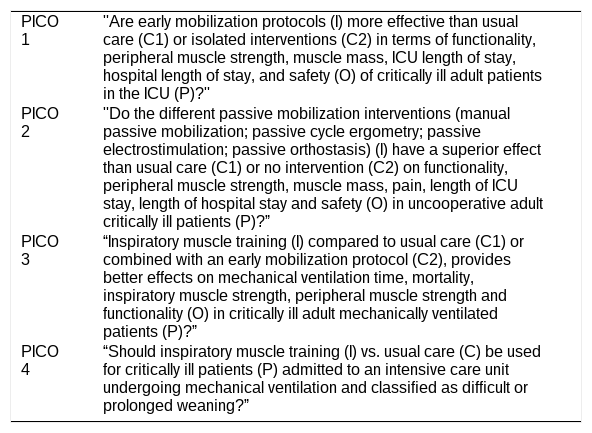
Guidelines’ scope and PICO frameworkThe guidelines focus on rehabilitation interventions for stable adult critical care patients aged 18 and older. PICO 1 focuses on patients able to cooperate and undergoing early mobilization interventions delivered through a systematized protocol. PICO 2 includes patients unable to participate in active early mobilization interventions, addressing passive interventions. PICO 3 pertains to patients receiving mechanical ventilation who are undergoing ventilator weaning. PICO 4 includes patients on mechanical ventilation experiencing prolonged or difficult weaning. Neurocritical conditions and children are beyond this guidelines’ scope. The management committee (MC) chairs formulated the initial PICO questions (P: population, I: intervention, C: comparison, and O: outcome), which the panelists refined and prioritized through voting. Outcomes for each PICO were ranked using GRADE methodology on a scale from 1 to 9, with categories including ‘critical’ (7–9), ‘important’ (4–6), or ‘of limited importance’ (1–3), based on their relative significance to patients.27 The Panel prioritized questions relevant and applicable to Brazilian settings and developed potential outcomes lists simultaneously. Four structured research questions are detailed in Chart 1, with comprehensive methods outlined in the Supplementary Materials, where the inclusion and exclusion criteria for each PICO are described in the corresponding Eligibility Criteria sections.
Structured research questions based on the PICO acronym (P: patient; I: intervention; C: control; I: intervention).
A comprehensive search was conducted for each PICO in the MEDLINE (via PubMed), Embase, Cochrane CENTRAL, LILACS, Scopus, and Web of Science databases. The strategy included terms related to population, intervention, and study type, targeting parallel or crossover randomized clinical trials published between 2009 and 2024, without language restrictions. The complete search strategy is in the Supplementary Material (PICO 1: Tables S6-S11; PICO 2: Tables S15-S20; PICO 3: Tables S24-S29; PICO 4: Tables S33-S38).
Studies were selected using the Covidence27 platform in two steps: preliminary assessment based on titles and abstracts and detailed reading of selected studies. Studies not meeting the criteria were excluded. Data extraction included identification, study design, participants, interventions, control group, outcomes, and results. Two independent assessors screened studies and extracted data, with a third resolving disagreements.
Two reviewers independently assessed the methodological quality of studies using the Risk of Bias 2.0 (ROB 2.0)28 tool, and a third resolved discrepancies by consensus.
Meta-analyses were done using Review Manager (RevMan) 5.4. The GRADE approach assessed evidence certainty, presented in a 'Summary of Findings Table' available through the GRADEpro tool.
Evidence summaries and formulation of recommendationsThe MT developed evidence summaries for each PICO question, including information on study design, population, intervention, pooled estimates of effect for each outcome, and a rating of the overall quality of evidence.
The MC created evidence summaries for each PICO question during an online meeting; the Panel developed recommendations based on the evidence summarized in the EtD. For each recommendation, the panel considered the quality of evidence, the balance between benefits and harms, values and preferences, economic implications and cost-effectiveness of the intervention, feasibility, and acceptability. The panel agreed on the recommendations (including direction and strength), remarks, and qualifications by consensus. In the event of disagreement, a proposed recommendation had to receive at least 80% of panel votes to be approved.
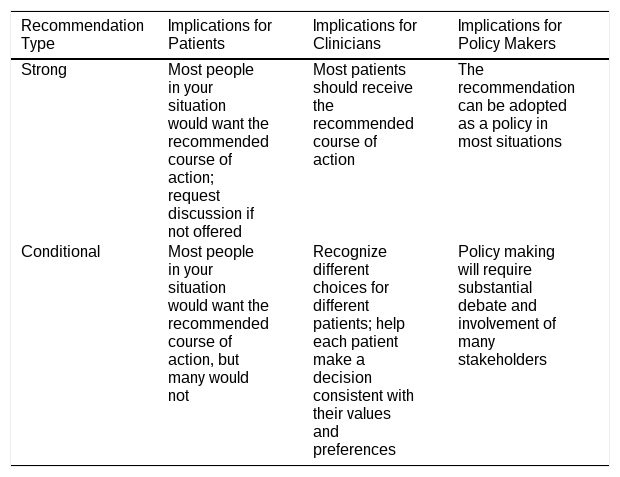
Interpretation of strong and conditional recommendationsThe recommendations are labeled as either “strong” or “conditional” according to the GRADE approach.26,29 The words “the guideline panel recommends” are used for strong recommendations, and “the guideline panel suggests” for conditional recommendations. The recommendations were considered strong when the Panel was confident that the desirable effects of adherence to a recommendation probably outweighed the undesirable effects. The recommendations were considered weak/conditional when the Panel concluded that the desirable effects of adherence to a recommendation probably outweigh the undesirable effects; however, it is only applicable to a specific group, population, or setting, or new evidence may result in changing the balance of risk to benefit; or the benefits may not warrant the cost or resource requirements in all settings. Table 1 provides the suggested interpretation of strong and conditional recommendations by patients, clinicians, and healthcare policymakers.
Implications of strong and conditional recommendations.
Remarks accompanying each recommendation are their integral parts and serve to facilitate a more accurate interpretation. The recommendations balanced health benefits and harms, providing practical guidance for rehabilitating ICU patients while minimizing potential harm and maximizing overall patient well-being.
Manuscript preparationFollowing the generation of recommendations, VM were divided into working groups. Each group focused on a specific PICO question, summarized the recommendation, provided a narrative summary of the evidence (highlighting the largest and most relevant clinical trials), and addressed issues raised in the EtD framework. The entire VM then reviewed and agreed upon the final wording of all recommendations and justifications.
Document reviewThe ASSOBRAFIR Scientific Board and the General Coordination of Scientific Documents reviewed the manuscript before submission for peer review and publication.
Dissemination and implementation toolThe guidelines will be disseminated through ASSOBRAFIR's official channels, including newsletters, website updates, and social media, to maximize their reach and adoption in clinical practice. Adequate specialized physiotherapists and IMT equipment are essential for fully implementing these guidelines. However, lacking qualified personnel, equipment, and a supportive ICU rehabilitation culture could hinder implementation. Panelists deemed the IMT device to be low-cost, which may facilitate the dissemination and implementation of this intervention across ICUs with diverse resource availability nationwide.
Editorial independenceThe VM and MC wrote the text according to data provided by the executive groups following the AGREE II and the Guideline Development Checklist documents.24 Following the Brazilian Journal of Physical Therapy submission rules, these guidelines were prepared to be independently evaluated through the editorial process, including peer reviewers.
Funding and updatingASSOBRAFIR General Executive Board totally funded the guidelines development to cover software, platform, and methodology team expenses. The funding body did not influence the content of the guidelines. All authors disclosed potential conflicts of interest, including financial, intellectual, and personal conflicts. ASSOBRAFIR Assembly will reevaluate the guidelines in three years to determine whether updating is warranted.
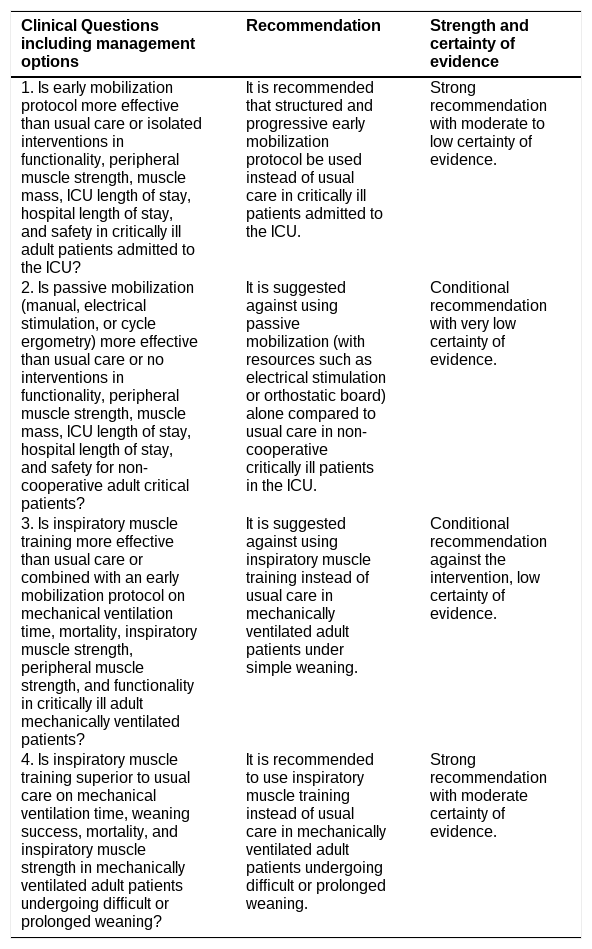
ResultsThe VM generated two conditional and two strong clinical practice recommendations, which are presented in Table 2. Please refer to the Supplemental Material for comprehensive details on the methods, certainty of evidence (CoE), EtD frameworks. The forest plots and evidence profiles provide additional insights into the included evidence. Table 2 summarizes the key recommendations provided in these guidelines and Table S39 summarizes the key research priorities for future trials.
Summary of key recommendations.
The guideline panel recommends using a structured and progressive early mobilization protocol instead of usual care (as defined in the Supplementary Material) in critically ill patients admitted to the ICU [Strong recommendation (SR), low to moderate certainty of evidence (LMCoE)].
Summary of the evidenceWe identified 26 studies, including 2950 participants from general ICU populations.6,7,30–53 Using a structured and progressive early mobilization protocol in the general adult ICU population may improve functionality [SMD 0.64 (95%CI 0.2 to 1.08), low certainty of evidence (LCoE)]. Also, it likely increases muscle strength slightly [SMD 0.26 (95%CI 0.11 to 0.41), moderate certainty of evidence (MCoE)], reducing hospitalization times in the ICU [MD -2.24 days (95%CI -3.69 to -0.79), MCoE] and total hospitalization time [MD -2.43 (95%CI -4.32 to -0.55), MCoE]. The adverse effects of early mobilization were considered small, with most of them deemed non-serious by studies. The intervention group had 8.2% adverse effects compared to 4.6% in the control group, resulting in a difference of 6 more per 1000 in the intervention group [RR 1.14; -0.33 to 3.96; very low certainty of evidence (VLCoE)].
JustificationThe panel voted for a strong recommendation, primarily considering the improvement of outcomes directly resulting from the intervention, such as muscle strength and functionality, and the consequent improvement such as length of hospital stay, with potential reduction in healthcare costs and low risk of adverse events. Although the overall CoE was low, mainly because most included studies were classified as having a high risk of bias, the panel considered that the potential benefits of the intervention outweighed these limitations. The panel experts considered the problem relevant because immobilization can significantly impact patients' independence and quality of life after ICU discharge. In addition, many ICUs still lack standardized protocols for patient mobilization. Early and progressive mobilization programs may improve functional recovery and reduce healthcare costs, including shorter hospital stays and a reduced need for post-discharge rehabilitation.
Other EtD criteria and considerationsThe recommendation is to use structured programs because they improve clinical outcomes like functionality and muscle strength, reduce ICU and general hospitalization length of stay by more than two days, potentially lower healthcare costs, and have a low incidence of minor adverse events. These effects were highlighted in the Hodgson 2022 study,40 likely due to the higher intensity of rehabilitation in the intervention group. In this sense, the balance between desirable and undesirable effects favors the intervention.
It is worth mentioning that the outcomes related to functionality have limitations in their assessment when using instruments that may not be sensitive enough to detect significant clinical variations, as their responsiveness has not been previously tested. The Barthel index was the most used instrument among the studies, even though it was developed for a population profile other than general intensive care.
Furthermore, in the sub-analysis grouping studies that used only exercises or exercises plus other resources in the intervention group, we observed that the addition of different resources, such as elastic bands, dumbbells, and games, provided more significant gains in muscle strength, without impact on functionality and shorter length of stay in the ICU without adverse events.
Recommendation PICO 2The guideline panel suggests against using passive mobilization (with resources such as electrical stimulation or orthostatic board) alone compared to usual care (as defined in the Supplementary Material) in non-cooperative critically ill patients in the ICU [conditional recommendation (CR), VLCoE].
Summary of the evidenceWe identified five studies, including 204 participants from general ICU populations.54–58 Using passive mobilization in the general adult non-cooperative ICU population may not decrease the length of ICU stay [MD 4.8 (95%CI -1.36 to 10.96), (VLCoE)]. Peripheral muscle strength was assessed in three studies,54,56,58 with 133 patients (two had used the Medical Research Council as a tool54,58). One study reported quadriceps strength, and another added several muscle groups. The third study56 used handgrip as a tool but it was not possible to perform a meta-analysis. A single study54 with 33 patients reported results of lower limb perimetry. Passive neuromuscular electrostimulation did not cause significant effects in relation to the control group. The length of hospital stay was assessed by a single study57 with 44 patients. Passive electrostimulation did not change this outcome compared to the control without intervention.
JustificationDue to the harm that immobility can cause to uncooperative patients in the ICU, passive mobilization performed manually or through technological advances, such as electrical stimulation, is presented as a potential prophylactic intervention with beneficial effects. Given the clinical scenario, it is justified to study passive interventions' effectiveness in improving important patient outcomes.
Despite this, the analyses of this systematic review using controlled trials showed that the different passive mobilization interventions (manual, cycle ergometry, electrical stimulation, and passive orthostasis) do not have a greater effect than usual care or no intervention. These interventions performed alone in this population do not influence the length of hospital stay, strength, and peripheral muscle mass, which suggests against their use in this context for the general critically ill population. For other outcomes, such as functionality and safety, no data was found in the literature and, therefore, could not be evaluated.
Other EtD criteria and considerationsIn the analysis of randomized clinical trials for decision-making, there was a lack of evidence for some outcomes, the risk of bias was classified as serious, and the CoE was very low. In the analysis of hospital stay, there was no difference related to passive mobilization, regardless of the method used compared to the control group. The results also showed no effect on peripheral muscle strength or muscle mass, irrespective of the assessment method. The fact that these interventions may require resources with moderate costs related to equipment, specialized staff, and training was also considered to guide the decision. The time involved in these interventions may lead to low acceptability by the health team regarding the effect. It is worth highlighting the restricted profile of patients with indications for passive mobilization since there is well-established evidence that the care bundles include increasingly alert and collaborative patients in the ICU.59,60
Recommendation PICO 3The guideline panel suggests against using inspiratory muscle training (IMT) instead of usual care (as defined in the Supplementary Material) in mechanically ventilated adult patients under simple weaning [CR against the intervention, (LCoE)].
Summary of the evidenceIMT was evaluated in ten RCTs with 653 participants.4,61–69 Four RCTs assessed maximal inspiratory pressure (MIP)61–64 which was significantly higher in patients randomized to IMT compared to usual care (total mean difference in cmH2O, 7.32; 95% CI 9.56, 5.08). However, for the duration of mechanical ventilation, there was no significant difference in the sample under simple weaning compared to IMT with usual care (two studies,61,63 117 patients, the mean difference in days, -3.59; 95% CI, -10.51, 3.33). The effects of IMT on functionality were investigated in one study using the “Acute Care Index of Function”, with no significant difference compared to usual care (95% CI -0.20 to 0.08). We recommend ongoing research measuring functional and adverse events among critically ill adult patients who undergo IMT.
JustificationThe panel experts suggest against IMT over usual care in patients undergoing simple weaning. Although IMT improved MIP, it did not affect the duration of mechanical ventilation, which was the most valued outcome among the included studies.
Recommendation PICO 4The guideline panel recommends using inspiratory muscle training instead of usual care (as defined in the Supplementary Material) in mechanically ventilated adult patients undergoing difficult or prolonged weaning [SR, (MCoE)].
Summary of the evidenceIMT was evaluated in five RCTs, including 321 patients with difficult or prolonged weaning.4,69–72 All the RCTs assessed MIP.4,69–72 which was significantly higher in patients randomized to IMT compared to usual care under (total mean difference in cmH2O, 17.65; 95% CI 10.08, 25.22). For the duration of mechanical ventilation, there was no significant difference compared to IMT with usual care (three studies,4,69,72 198 patients, the mean difference in days, -0.31; 95% CI, -4.29, 3.67). IMT significantly increased the chance of weaning success (three studies,4,71,72 210 patients, RR, 1.61; 95% CI, 1.29, 2.01) and reduced mortality (two studies,4,69 171 patients, RR, 0.63; 95% CI, 0.40, 0.97).
JustificationThe panel recommends IMT for patients undergoing difficult or prolonged weaning based on moderate certainty of evidence regarding its effects on clinically relevant outcomes, such as mortality, and weaning success from mechanical ventilation.
Other EtD criteria and implementation considerationsThe initiation of IMT in adult patients must consider those who have failed their first ventilator withdrawal attempt. The patient should have stable cardiovascular status, temperature < 38 °C, arterial oxygen saturation (SaO2) greater than 90% with a FiO2 less than or equal to 0.4, low positive end-expiratory pressure (PEEP): 5–8 cmH2O, and respiratory rate ≤ 35 bpm. IMT can be implemented using pressure threshold loading valves (lower cost) or electronic devices that dynamically adjust flow resistance to generate the load (higher cost), depending on the financial resources available in each unit. Based on the RCTs included in the meta-analyses, which demonstrated better clinical outcomes4,69,71 IMT should be conducted once daily (weekdays) with an inspiratory load of ≥ 40% of the patient's MIP.4 The IMT regimen should consist of 2 sets of 30 breaths4 or 5 to 6 sets of 6 to 10 breaths69,71 per day, with a resting period of 2–3 min between sets. The load should be adjusted every 7 days4 or progressed daily as tolerated.71
DiscussionThese guidelines represent a significant advancement for physiotherapy practice in intensive care units, providing relevant recommendations for structuring therapeutic plans for critically ill adult patients, aiming at functional independence and successfully weaning from ventilators. Over the past decade, several studies and systematic reviews have investigated early mobilization and rehabilitation interventions in the intensive care unit, highlighting their potential to improve functional outcomes and reduce complications associated with prolonged immobility. Recently, Hodgson et al. (2025) published clinical practice guidelines focusing on physical rehabilitation and mobilization in mechanically ventilated ICU patients.23 While those guidelines provide important recommendations for early mobilization practices, interventions such as inspiratory muscle training (IMT) and passive mobilization strategies were outside their scope. Therefore, the present guidelines expand the current evidence base by addressing these physiotherapy-specific interventions and by providing recommendations tailored to different ventilator weaning scenarios. The use of internationally recognized methodologies, such as AGREE-II and GRADE, ensures scientific rigor and transparency in the development process, while minimizing selection bias.
Among the recommendations, several key points warrant emphasis. Primarily, structured and progressive early mobilization was strongly recommended when compared to usual care. Although the certainty of the evidence ranged from low to moderate, the observed clinical benefits observed, such as improvements in peripheral muscle strength, functional status, and reductions in both intensive care unit and overall hospital length of stay, clearly outweighed the associated risks, which were deemed minor and non-serious. This recommendation underscores the importance of implementing standardized mobilization protocols in intensive care units, with the potential to mitigate complications arising from prolonged immobility. This reduction in the length of ICU stay corroborates the meta-analysis by Wang et al. (- 2.18 days; - 4.22 to - 0.13)73 and is somewhat contrary to the results of the meta-analysis by Paton et al.,74 which did not identify a difference in the number of hospital-free days in 180 days (4.28 days; -4.46 to 13.03), but observed an improvement in physical function in six months (0.2; 0.09 to 0.32). The results of these guidelines can be justified by the selection of studies with the structuring of a systematic and progressive mobilization protocol, since recent literature has already demonstrated that there was no evidence of a cost-effectiveness relationship of a high dose of mobilization in relation to usual care ($1.823; - 10.552 to 12.027) .75
In contrast, interventions limited to passive mobilization, including modalities such as passive cycle ergometry, electrical stimulation, and orthostatism, demonstrated no significant effects on clinically relevant outcomes. A conditional recommendation against their use was therefore issued, supported by evidence of very low certainty. Beyond the lack of demonstrated clinical benefit, considerations related to costs and the requirement for specialized human and material resources were also weighed, as these factors may further limit the acceptability and feasibility of implementing such interventions in clinical practice. Recently, a cost-effectiveness analysis study of adding a cycle ergometer to the usual mobilization care protocol found no difference in costs per patient over 90 days (CA$ 5.841; -7.666 to 18.797) .76 These findings reinforce the need for caution in indicating passive interventions, although in this latest study, the intervention was performed within a protocol and not necessarily non-collaborative. Additionally, although not included in the systematic review because it did not meet the eligibility criteria of being a parallel or crossover randomized controlled trial, a recent study comparing manual passive mobilization with usual care also reported no benefit in reducing joint stiffness, further supporting the limited clinical value of passive-only mobilization strategies.77
Future studies that evaluate systematized mobilization protocols with and without these interventions are essential for evaluating the real effectiveness of mobilization on hospital and post-discharge outcomes, as well as dosage and cost analyzes, in both cooperative and uncooperative patients.
Another key aspect highlighted in these guidelines was inspiratory muscle training (IMT). Outcomes varied according to the weaning profile (simple, difficult, or prolonged). Simple weaning refers to successful extubation after the first spontaneous breathing trial (SBT); difficult weaning involves up to three SBTs or up to seven days from the first SBT to achieve extubation; and prolonged weaning is defined as failure of at least three attempts or the need for more than seven days of weaning after the first SBT.78 For individuals undergoing simple weaning from mechanical ventilation, although improvements in maximal inspiratory pressure (MIP) were observed, there was no significant impact on ventilation duration or functional outcomes. Recent evidence from a systematic review and meta-analysis similarly demonstrated improvements in inspiratory muscle strength with IMT in mechanically ventilated patients, although consistent benefits in clinically meaningful outcomes remain uncertain.79 Consequently, the panel suggested against routine use of IMT in this group, issuing a conditional recommendation.
Although the meta-analysis by Worraphan et al22 demonstrated positive effects of IMT associated with conventional physiotherapy on the duration of ventilator weaning (-2.6 days; -4.76 to -0.45), as well as that of Vorona et al21 (-2,3 days; -0.7 to -4.0), these included patients undergoing simple and prolonged weaning. Complementarily, the meta-analysis by Worraphan et al22 also found that early mobilization had positive effects on reducing the duration of mechanical ventilation (-2.01 days; -3.81 to -0.22). Although these interventions were not directly compared, these findings suggest that mobilization strategies may be particularly relevant in patients undergoing simple weaning, especially considering that the present guidelines did not identify significant effects of IMT on the duration of mechanical ventilation.
In patients experiencing difficult or prolonged weaning, IMT proved effective, leading to higher weaning success rates and reduced mortality, which supported a strong recommendation based on moderate-certainty evidence. These findings underscore that IMT prescription should be targeted and judicious, prioritizing patients with the highest potential for benefit. Despite the lack of difference in the time of mechanical ventilation in relation to the two previous meta-analyses,21,22 which included patients with only prolonged weaning, the significant benefit in respiratory muscle strength in this meta-analysis may have increased the chance of successful weaning, as well as demonstrated a reduction in mortality. Future studies are needed to confirm these findings, as well as to evaluate long-term outcomes.
Nevertheless, several limitations must be acknowledged. Some included studies exhibited moderate to high risk of bias, small sample sizes, and heterogeneity in applied protocols, which reduces confidence in the findings. These limitations justify the classification of the certainty of evidence as low for several outcomes.
Strong recommendations (early mobilization and IMT in difficult or prolonged weaning) should be incorporated into standard care whenever feasible, whereas conditional recommendations (against isolated passive mobilization and IMT in simple weaning) highlight the importance of tailoring rehabilitation strategies according to the patient’s profile.
ConclusionThese clinical practice recommendations guide intensive care professionals in structuring appropriate therapeutic plans for critically ill patients aiming to prevent, minimize, or rehabilitate physical and/or respiratory dysfunctions. The guidelines reinforce the importance of systematic and progressive physical and functional rehabilitation and the appropriate selection of patients with difficult or the assertive prescription of inspiratory muscle training. Clinicians are encouraged to adopt these recommendations to improve patient outcomes, while researchers are urged to address the evidence gaps to strengthen future guidelines.
The authors declare no competing interest. No external funding influenced the content or recommendations of this guideline, which were developed independently based on current evidence.
The authors thank the Brazilian Association of Respiratory Physiotherapy, Cardiovascular Physiotherapy, and Physiotherapy in Intensive Care (ASSOBRAFIR) for its support in developing this guideline. We also acknowledge the contributions of the guideline committee, external reviewers, and collaborating healthcare professionals. We additionally thank Ricardo Kenji Nawa for his valuable contributions to the development of this guideline.



articles