A severe exacerbation of COPD (ECOPD) may negatively impact patients’ functioning; however, there is a lack of validated, simple, and low-cost tools to assess physical function in this setting. Thus, the aims of this study were to explore the construct validity of the five-repetition sit-to-stand (5STS) test for assessing muscle strength and exercise tolerance, and to investigate its prognostic value in predicting exacerbation-related readmission risk in patients with severe ECOPD.
MethodsThis was a prospective observational study. Fifty-eight patients hospitalized with a severe ECOPD were included. At hospital discharge, the 5STS, quadriceps force, six-minute walk test (6MWT), COPD Assessment Test (CAT), and modified Medical Research Council scale were assessed. Exacerbation-related readmissions within six months were collected. Statistical analyses included correlation analysis, receiver operating characteristic (ROC) curve, and Kaplan-Meier survival analysis.
Results58 patients (mean age of 69 ± 8 years, 45% male, FEV1 41 ± 16% predicted) were included. Within six months, 31% were readmitted. The 5STS showed a significant negative correlation with quadriceps force (r = -0.487) and 6MWT (r = -0.415). The ROC curve analysis demonstrated an AUC of 0.720 (95% CI: 0.588–0.853), with a cut-off of ≥13 seconds identifying patients at higher risk of exacerbation-related readmission. Patients with 5STS <13s had a higher probability of remaining hospitalization-free (86.7%) compared to those with 5STS ≥13s (50%).
ConclusionThe 5STS is correlated with muscle strength and exercise tolerance and has acceptable prognostic value for predicting exacerbation-related admission within six months in patients with severe ECOPD.
Hospitalization for a severe exacerbation of COPD (ECOPD) negatively impacts functioning, leading to reduced exercise capacity, quadriceps force, and daily physical activity levels.1,2 Measures of physical function during hospitalization have been shown to predict poor recovery, future exacerbations, and mortality.2–4 Thus, assessing physical function in these patients during hospitalization is important for guiding early personalized care.
A routine functional test during hospitalization for ECOPD should be simple, low-cost, easy to administer, and valid. The five-repetition sit-to-stand test (5STS) meets these criteria in patients with stable COPD, showing correlations with quadriceps strength and exercise capacity, and predicting mortality and exacerbation risk.5–7 However, to the best of our knowledge, no studies have explored its validity during hospitalization.8 Therefore, the aims of this study were to explore the construct validity of the 5STS test to assess muscle strength and exercise tolerance in patients with severe ECOPD, and to investigate its prognostic value in predicting exacerbation-related readmission risk.
MethodsThis is a sub-analysis of a prospective observational study conducted between July 2019 and March 2020.3 The study was approved by the Medical Ethical Committee (Eudract-B-nr: B371201732540, July 2017) and participants provided informed consent. Hospitalized patients with a doctor-confirmed ECOPD were invited to participate in the study. Exclusion criteria comprised admission to the intensive care unit, presence of other lung diseases, unstable cardiovascular disease, and orthopedic, cognitive, or neurological disorders that impaired the ability to comply with study procedures. Patients were assessed on the day of discharge. Data on exacerbation-related hospitalization in the previous year, as well as exacerbation-related readmission within six months, were collected from hospital records. Sociodemographic information (age and sex), anthropometric measurements (height and weight), and clinical data (smoking status, pack-years, and comorbidities recorded in hospital records) were also registered.
The 5STS was assessed according to the protocol described by Jones, et al.,7 wherein patients were asked to rise from and sit down on a standardized chair (height of
48cm) five times with their hands folded across the chest, as fast as possible. Muscle strength was assessed by isometric quadriceps force (QF) using a hand-held dynamometer (Microfet, Biometrics, NL),3 and compared with normative values.9 Exercise tolerance was assessed using the six-minute walk test (6MWT) conducted in a 30 m corridor, according to the European Respiratory Society/American Thoracic Society (ERS/ATS) guidelines10 and compared with reference values.11 Given the acute setting, the 6MWT was only performed once. Additionally, dyspnea was assessed using the modified Medical Research Council dyspnea scale (mMRC), and disease impact was assessed using the COPD Assessment Test (CAT). The most recent post-bronchodilator spirometry during stable condition - performed at least three months after an ECOPD and according to the ATS/ERS guidelines12 - was retrieved from hospital records to evaluate lung function.
All statistical analyses were carried out using the Statistical Package for Social Sciences (version 20.0, IBM SPSS, Armonk, NY, United States). Continuous variables were expressed as mean ± SD or median (interquartile range), and categorical variables were presented as counts (percentages). The normality of continuous data was verified using the Shapiro-Wilk test. To evaluate construct validity, Spearman’s correlation coefficients were calculated to verify the association between 5STS and muscle strength and exercise tolerance. Based on a previous study,7 it was hypothesized that there would be low-to-moderate negative correlations (r = −0.30 to −0.60) between these variables. Prognostic capacity was assessed by constructing receiver operating characteristic (ROC) curves to determine whether the 5STS could predict the risk of exacerbation-related readmission within 6 months. The optimal cut-off point on the curve was defined based on the highest Youden Index. Patients below or above the cut-off point on the 5STS were compared using an independent t-test, Mann-Whitney U test, chi-square test, or Fisher's exact test, as appropriate. Kaplan-Meier survival analysis was used to estimate 6-month hospitalization-free survival and to compare groups based on the 5STS cut-off. The log-rank test was applied to assess differences between survival curves. Additionally, an exploratory binary logistic regression analysis was performed to adjust the association between 5STS (continuous variable) and exacerbation-related readmission risk for potential confounders, including age, body mass index (BMI), length of stay (LoS), and forced expiratory volume in the first second (FEV1).
This study is a sub-analysis of a prospective observational study, and no a priori sample size calculation was performed specifically for the present analyses. Therefore, a power analysis was performed for the ROC analysis based on the available sample, the observed AUC, a null hypothesis AUC of 0.50, and an α of 0.05.
ResultsA total of 58 patients with severe ECOPD were included (age 69±8 years, 55% male, FEV1 41±16%pred). Patient characteristics are presented in Table 1. Eighteen patients (31%) were readmitted within six months after discharge, and among them, six died.
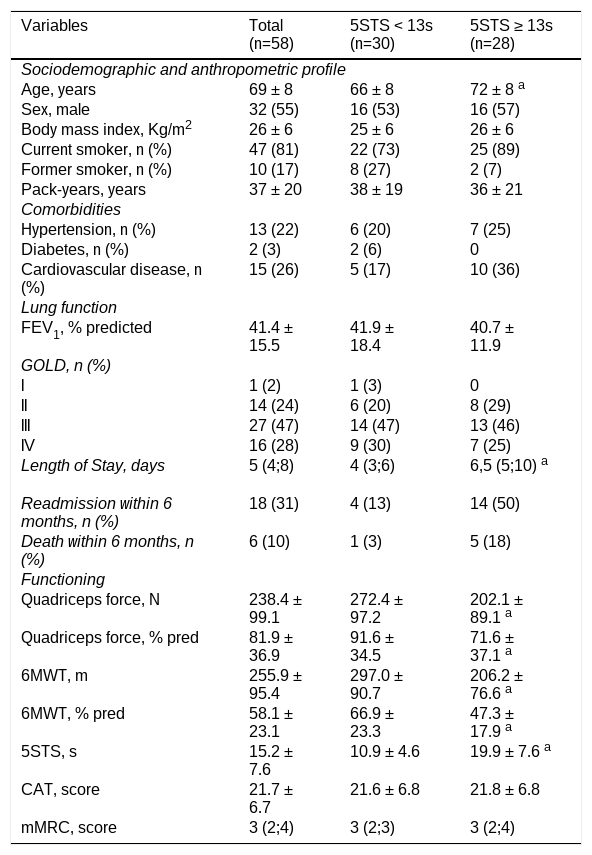
Sociodemographic, anthropometric, and clinical characteristics of the sample, and comparison between groups below and above the cut-off point in the 5STS test.
Data are expressed as mean ± SD, number (percentage), or median (quartile 1 – quartile 3). FEV1: forced expiratory volume in the first second; 5STS: 5-repetition sit-to-stand test; 6MWT: Six-minute walk test; CAT: COPD Assessment Test: mMRC: modified Medical Research Council. a: p<0.05 in the comparison between groups.
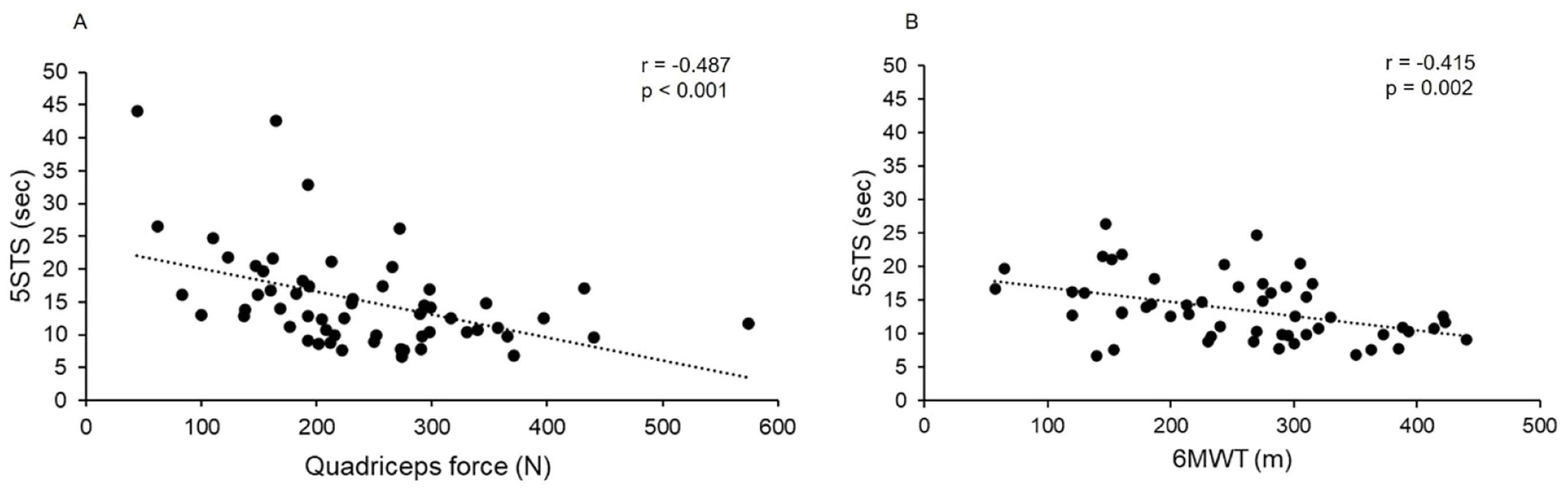
The 5STS showed a statistically significant negative correlation with QF (r = 0.487, p < 0.001) and 6MWT (r = -0.415, p = 0.002, n = 53) (Fig. 1). As shown in Fig. 1, five patients were unable to perform the 6MWT, including those identified as the weakest according to the 5STS. According to the ROC curve analysis, the 5STS identified exacerbation-related readmission risk within six months, with an AUC of 0.720 (95% CI: 0.588–0.853). Based on the available sample and the observed AUC, the estimated statistical power of the ROC analysis was 80.2%. A cut-off of ≥ 13 seconds was defined, with a sensitivity of 83%, a specificity of 63%, and the best Youden Index of 0.46. The association between the 5STS and readmission risk remained significant after adjusting for age, BMI, LoS, and FEV1 (OR: 1.11, 95% CI: 1.01–1.22, p = 0.025), indicating that the 5STS predicts higher readmission risk beyond these clinical factors.
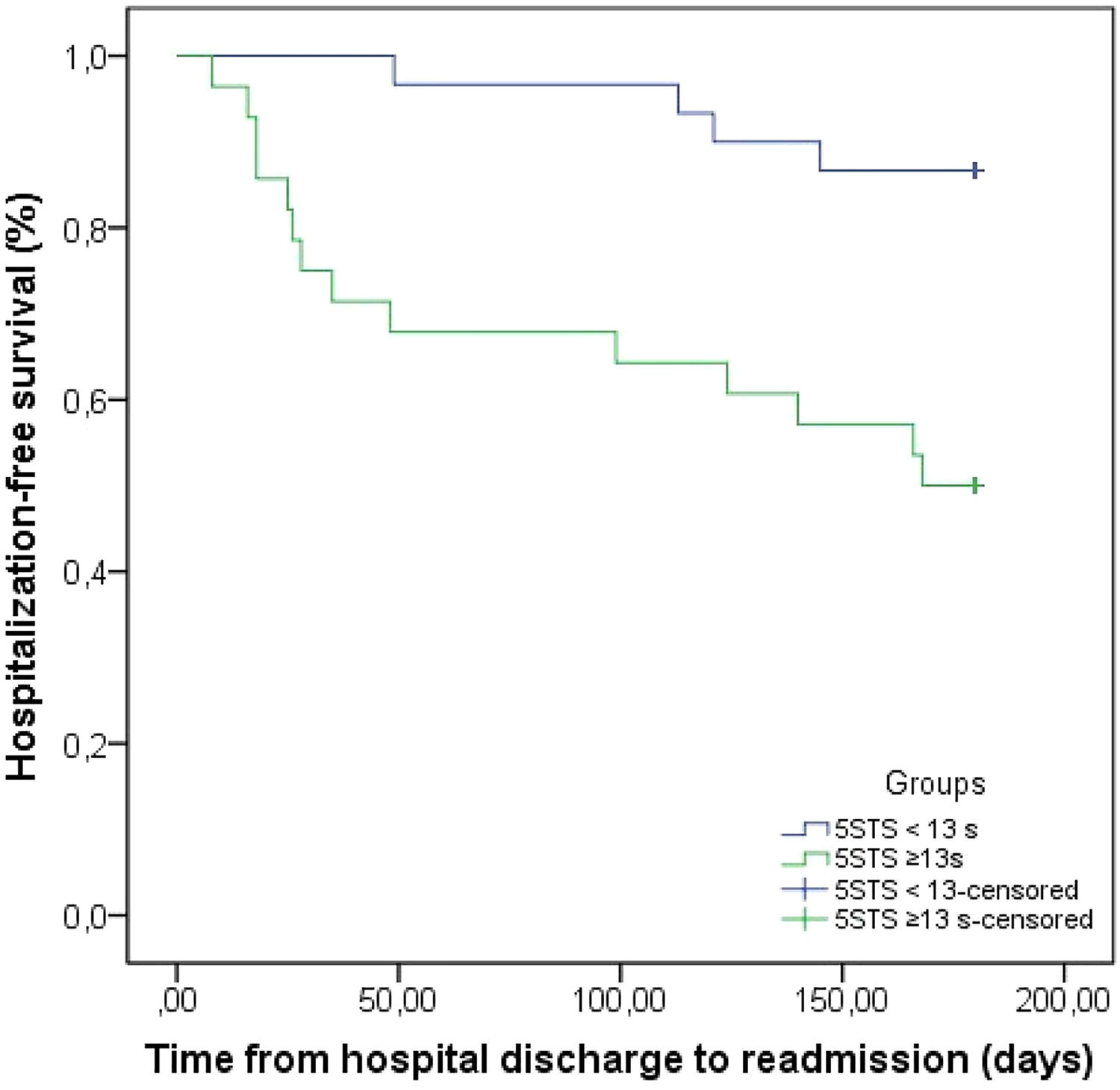
The overall hospitalization-free survival rate was 69.0%. Patients with 5STS < 13s had a higher probability of remaining hospitalization-free (86.7%) compared to those with 5STS ≥ 13s (50%) (Fig. 2). A log-rank test confirmed a statistically significant difference in hospitalization-free survival between groups (χ² = 9.860, df = 1, p = 0.002).
Kaplan-Meier curve of 6-month hospitalization-free survival among patients with severe ECOPD. The lines represent groups stratified by the 5STS cut-off (≥13s vs. <13s) at hospital discharge. The log-rank test showed a significant difference between survival curves (p = 0.002), indicating a lower probability of hospitalization-free survival in patients with 5STS ≥13s compared to those with <13s.
Table 1 also presents the characteristics of patients with a 5STS below and above the proposed cut-off. Patients with 5STS ≥ 13s had weaker quadriceps strength and lower exercise capacity, while the severity of airflow limitation did not differ between groups.
DiscussionThe main findings of this analysis indicate that the 5STS test is negatively correlated with QF and 6MWT. Additionally, a cut-off ≥13 seconds demonstrated acceptable prognostic value for predicting exacerbation-related readmission within six months in patients with severe ECOPD. Kaplan-Meier survival analysis further showed that patients with 5STS < 13s had a significantly higher probability of remaining hospitalization-free compared to those with 5STS ≥ 13s. An exploratory multivariable logistic regression confirmed that the 5STS performance remained significantly associated with readmission risk after adjusting for BMI, age, LoS and FEV₁.
The 5STS is considered a valid functional outcome measure that encompasses multiple components of functioning, including muscle strength and exercise tolerance.7 Our study confirms this in a sample of patients hospitalized for an acute respiratory event. In terms of setting, the hospital is an acute care environment with space and time constraints, and a simple, easy-to-administer, low-cost instrument, such as the 5STS, to measure functioning is an interesting alternative. However, given the low-to-moderate strength of the observed correlations, a complementary assessment of muscle strength and exercise capacity may be useful in informing a personalized rehabilitation approach.
Regarding the prognostic capacity of the 5STS, Medina-Mirapeix et al., 2021,6 identified a cut-off of > 13.7 seconds to predict the risk of severe exacerbation in patients with stable COPD. This is in line with our findings, suggesting that a cut-off of 13-14 seconds might be useful across different disease states in patients with COPD. Knowledge of this cut-off could help health professionals identify patients at risk of poor prognosis, aiding prioritization of healthcare.
Important limitations of this study are the use of the 6MWT only once due to low patient tolerability, the small sample size that may limit generalizability, and the identification of a cutoff without covariate adjustment.
ConclusionThe 5STS is low to moderately correlated with muscle strength and exercise tolerance in patients with severe ECOPD. Additionally, 5STS has an acceptable prognostic value for predicting exacerbation-related admissions within six months, with a cut-off of ≥13 seconds.
FundingNaiara Leonardi was supported by CAPES-Print from UFSCar (88887.889045/2023-00): Ana Machado was supported by Bijzonder Onderzoeksfonds – Bilaterale Samenwerking (BOF BILA) from Hasselt University (DOC/SCHL-BOSE/190/522 The funding source had no involvement in this analysis or in the writing of this manuscript.
The authors declare no conflicts of interest. The funders had no role in the design of the study, the collection, analysis, or interpretation of data, the writing of the manuscript, or the decision to publish the results.
The authors would like to acknowledge the support of all the patients who agreed to participate in this study and their families. We also want to thank the institution and staff involved in the recruitment process.