

Osteoarthritis is the most common joint disease worldwide and the leading cause of disability related to joint conditions. There are few relevant musculoskeletal pain measures adapted to Brazilian Portuguese, and the Central Aspects of Pain in the Knee (CAP-Knee) is not yet available in this language version.
ObjectiveTo cross-culturally adapt and evaluate the measurement properties of the Brazilian Portuguese version (Br) of the CAP-Knee.
MethodsThis was a methodological study with two phases: (1) the CAP-Knee was translated and cross-culturally adapted into Brazilian Portuguese; (2) measurement properties were tested. Patients with knee osteoarthritis (n = 130) completed the CAP-Knee-Br, as well as pain and central sensitization measures. Structural validity was assessed using exploratory and confirmatory factor analyses. Furthermore, standard error of measurement, minimal detectable change, percentage of standard error of measurement error, floor and ceiling effects, McDonald’s omega (internal consistency), and the intraclass correlation coefficient (test–retest reliability) were calculated.
ResultsThe CAP-Knee-Br showed cross-cultural equivalence with the original version. Exploratory and confirmatory factor analysis replicated the original one-dimensional structure with 8 items. We found positive correlations between the CAP-Knee-Br with pain and central sensitization measures. The standard error of measurement, the minimal detectable change, and the percentage of the standard error of measurement were all good. No floor or ceiling effects were observed. The CAP-Knee showed good reliability with adequate internal consistency (0.76 [95% CI: 0.69, 0.82]) and good test-retest stability (0.89 [95% CI: 0.84, 0.94]).
ConclusionThe CAP-Knee-Br proved to be a valid and reliable instrument for assessing the central aspects of pain in Brazilian individuals with knee osteoarthritis.
Data from the Global Burden of Disease studies showed that chronic pain has been identified as one of the leading causes of disability worldwide.1,2 In the United States, the prevalence of chronic pain ranges from 11% to 40%, while in the United Kingdom it approaches 44%.1 In Brazil, the prevalence of chronic pain in the adult population ranges from 23% to 42%.2 Among the ten most common pain complaints are back pain, osteoarthritis, and headaches.1 Evidence indicates that the burden of chronic pain disproportionately affects women, older adults, individuals with lower socioeconomic status, and those living in rural areas.1,2
Among the chronic musculoskeletal pain, osteoarthritis-related pain stands out. Globally, osteoarthritis is the most common joint disease and the leading cause of disability associated with joint conditions. Current estimates indicate that it affects approximately 595 million people worldwide, with a higher prevalence among older adults.3 In populations aged 60 and older, about 10% of men and 18% of women are affected. Its prevalence has increased by 132.2% over the past 30 years, with projections indicating an additional rise of 60% to 100% by 2050.3–7 The global age-standardized rate of years lived with disability due to osteoarthritis was 255.0 (95% CI: 119.7, 557.2) per 100,000 in 2020, representing nearly a 60% increase compared to the 1990s.3 In Brazil, this rate has shown substantial growth, rising from 140.14 per 100,000 (95% CI: 67.0, 281.5) in 1990 to 301.29 per 100,000 (95% CI: 144.6, 607.6) in 2021.8 The knee is the most commonly affected joint, accounting for 83% to 85% of osteoarthritis cases.9,10
Osteoarthritis is diagnosed through clinical and/or radiological examination.11 Clinical diagnosis has certain limitations, as symptoms can fluctuate substantially over time and are influenced both by the underlying pathology and pain pathway modulation. Furthermore, clinical signs may only become apparent once the disease has reached an advanced and irreversible stage. Structural diagnosis using imaging should be approached with caution, although it can enable earlier detection and the implementation of interventions to modify the disease's structural progression at its onset.5 Osteoarthritis is a complex condition affecting the entire joint, causing structural changes in both the articular cartilage and subchondral bone.5 Degenerative processes also occur in the synovial membranes, joint capsule, ligaments, and periarticular muscles.
These changes can further lead to limitations in range of motion, bone instability, edema, and crepitus, as well as psychological distress related to pain. Pain is the most prominent symptom.9 This type of pain may present spontaneously or be induced by movement. The intensity and severity of pain are not necessarily directly related to the degree of structural osteoarthritis observed; however, structural changes can still be relevant contributors to pain.11 Chronic pain can induce alterations in the brain, such as central sensitization. The central nervous system can modify, distort, or amplify pain, increasing its intensity, duration, and spatial extent, potentially resulting in a discrepancy between pain severity and the degree of joint impairment.12
Currently, there are some measures designed to assess the adverse impacts of knee osteoarthritis, such as the Western Ontario and McMaster Universities Osteoarthritis Index13 and the Knee Injury and Osteoarthritis Outcome Score.14 However, both measures were developed prior to the new International Classification of Diseases (ICD-11),15 and the understanding of pain at that time does not reflect current research and discoveries on the topic. This may introduce assessment bias, as until the ICD-10, pain was attributed solely to an underlying pathophysiological mechanism, being considered only as a symptom of the degenerative process.
Interestingly, there is one available self-report assessment tool, the Central Aspects of Pain in the Knee (CAP-Knee), which assesses individuals with knee osteoarthritis who exhibit central pain mechanisms.16 Psychometric properties were evaluated in a sample of 250 participants aged 40 years or older who reported knee pain on most days in the past month.16 Confirmatory factor analysis supported the unidimensional structure of the CAP-Knee.16 The CAP-Knee demonstrated moderate to strong associations with pain severity, as measured by both the sensory and affective domains of the McGill Pain Questionnaire.16 Internal consistency was good (Cronbach’s α = 0.74), and test–retest reliability was excellent, with a retest interval of 17–24 days (ICC2,1 = 0.91; 95% CI: 0.86, 0.94]).16
However, the CAP-Knee is not yet available in Brazilian Portuguese, and its measurement properties were not tested among Brazilians. Thus, the present study aimed to cross-culturally adapt the CAP-Knee into Brazilian Portuguese and to analyze its measurement properties. Specifically, we aimed to perform the translation, synthesis of translations, back-translation, expert committee review, and pre-testing of the original and translated versions of the CAP-Knee. Additionally, we sought to analyze the construct validity (structural validity and hypothesis testing), reliability (measurement error, internal consistency, and test-retest reliability), and floor/ceiling effects of the Brazilian CAP-Knee version (CAP-Knee-Br).
MethodsStudy designThis is a methodological study focused on the cross-cultural adaptation and evaluation of the measurement properties of the CAP-Knee questionnaire for Brazilian Portuguese. The study was conducted in two stages. The first stage involved the translation and cross-cultural adaptation of the CAP-Knee (including synthesis of translations, backtranslation, expert committee review, and pre-testing of the original and translated versions).17,18 The second stage focused on assessing the measurement properties of the adapted Brazilian Portuguese version (construct validity [structural validity and hypothesis testing], reliability [measurement error, internal consistency, and test-retest reliability], and floor/ceiling effects of the Brazilian version of the CAP-Knee [CAP-Knee-Br]).
The study was conducted in accordance with the Declaration of Helsinki and approved by the Ethics Committee of the Universidade Federal de Juiz de Fora (approval number: 6.541.021).
Translation and cross-cultural adaptationThe translation and cross-cultural adaptation were conducted in accordance with standardized guidelines.17,18 The translation (two independent translators; one lay translator and one specialized in osteoarthritis), synthesis of translation (accordance between the two translators), and back-translation (two independent, lay back-translators) were carried out. Next, semantic, idiomatic, cultural, and conceptual equivalences were obtained between the original and the Brazilian version of the CAP-Knee through an expert committee,17 composed of two physiotherapists and two clinicians with expertise in pain and osteoarthritis, one expert in cross-cultural adaptation, and one linguist.
The expert committee developed the pilot test version, which was then administered individually (i.e., as a self-administered questionnaire) to 30 participants who reported knee pain on most days in the past month and had a radiographic diagnosis of knee osteoarthritis with a Kellgren-Lawrence grade ≥1.19 Individuals with neurological conditions and those unable to read were not included. To assess the degree of verbal comprehension of each item, participants were instructed to respond to the question, “How well did you understand each question/item?” using a 5-point Likert-type scale from 0 (did not understand at all) to 5 (completely understood with no doubts). The CAP-Knee is a self-report questionnaire; therefore, no additional standardized instructions or guidance were provided to participants beyond the original instrument protocol, except to clarify any doubts raised during completion.
Evaluation of the measurement propertiesParticipantsFor the assessment of the measurement properties of the CAP-Knee-Br, a convenience sample of 130 participants, both men and women aged ≥40 years, who reported knee pain on most days in the past month and had a radiographic diagnosis of knee osteoarthritis with a Kellgren-Lawrence grade ≥1,19 provided consent to participate in the study and were able to communicate in Brazilian Portuguese. Individuals with neurological conditions and those unable to read were not included. The sample included in the measurement properties phase has sociodemographic characteristics similar to the pilot test sample.
Participants were excluded if they self-reported an autoimmune disease or inflammatory arthritis, such as rheumatoid arthritis, as these conditions fall under a different pain subclassification,11 if they presented clinical instability during data collection, or if they scored below the expected threshold in the Mini-Mental State Examination (MMSE),20 specifically: 18 points for individuals with 1 to 8 years of education and 26 points for those with 8 or more years of education.21
All participants were invited to complete the sociodemographic questionnaire and the CAP-Knee Br again after a two-week interval to assess test–retest reliability. Responses were obtained from 58 participants.
ProceduresData collection was conducted at two sites in Juiz de Fora, Brazil: a public university hospital (University Hospital of the Federal University of Juiz de Fora) and a private clinic (Prosport). The participants completed sociodemographic and clinical questionnaires, the CAP-Knee,16 the short form of the McGill Pain Questionnaire,22 the Numerical Pain Scale,22,23 and the Central Sensitization Inventory.24 The sample size exceeded the requirement for exploratory (EFA) and confirmatory factor analysis (CFA), which typically necessitates 10 participants per item.25
Data analysisDescriptive analysis and measurement properties of the CAP-Knee-Br were run in JASP v. 0.19.1. Data distribution was assessed through skewness (Sk < 3) and kurtosis (Ku < 7) analyses, as well as the Shapiro-Wilk test for normality. Missing data were inspected.26 Categorical variables were analyzed using absolute and relative frequencies (%), while continuous and/or ordinal variables were summarized using mean (M) and standard deviation (SD), along with minimum and maximum values.
The construct validity of the CAP-Knee-Br was evaluated through structural validity and hypothesis testing. The sample (n = 130) was divided into two subsamples: the first was used for EFA (n = 65) and the second for CFA (n = 65). To assess the factorability of the data, the Kaiser-Meyer-Olkin (KMO) measure and Bartlett’s test of sphericity were used.25 The KMO test indicates the adequacy of applying EFA to the dataset, with values above 0.70 considered satisfactory.25 Bartlett’s test of sphericity evaluates the significance of correlations in the data matrix, with p-values < 0.05 considered significant.25
Factor extraction was subsequently performed using the principal axis factoring method with oblique rotation (Promax), given the instrument's unidimensionality,16, while allowing multidimensional solutions in which factors may be correlated. The number of factors to retain was determined using the following criteria: parallel analysis,27 minimum eigenvalue of 1 (Kaiser’s criterion), and scree plot inspection. Items loading onto a factor were considered adequate if factor loadings (λ) were greater than 0.40. Items with cross-loadings on multiple factors (λ > 0.32) were excluded.25 Communalities were inspected and deemed adequate if > 0.16.25 Total explained variance above 30% was considered acceptable.25
Subsequently, CFA was conducted. Outliers were assessed using Mahalanobis squared distance (D²). CFA was performed using the weighted least squares mean and variance adjusted (WLSMV) estimation method. Model fit was evaluated using the following indices.25,28 chi-square/degrees of freedom ratio (χ²/df < 3), Comparative Fit Index (CFI ∼ 0.95), Tucker-Lewis Index (TLI ∼ 0.95), Root Mean Square Error of Approximation (RMSEA < 0.08 [90% CI; p > 0.05]), and Standardized Root Mean Square Residual (SRMR < 0.08).
Data from the total sample were used to assess construct validity (hypothesis testing). Spearman’s correlation coefficient was used to examine the association of the CAP-Knee-Br with the McGill Pain Questionnaire (sensory, affective, pain in the last days, and pain “now” subscales),22 with the Central Sensitization Inventory (physical symptoms, emotional distress, headaches and jaw pain, and urological symptoms subscales),24 and with the Numerical Pain Rating Scale.22,23 Given that the CAP-Knee captures central aspects of pain, it is expected to positively correlate with the above-mentioned measures. Correlations were interpreted as small (0.10–0.29), moderate (0.30–0.49), or large (≥ 0.50).29
The reliability of the CAP-Knee-Br (retest sample = 58 participants) was assessed through measurement error, internal consistency, and test-retest reliability. To evaluate agreement, the standard error of measurement (SEM = SD × √(1 – intraclass correlation coefficient [ICC])) and the minimal detectable change (MDC = 1.96 × √2 × SEM) were calculated.30 The percentage of standard error of measurement relative to the total questionnaire score is suggested by Ostelo et al. (2004)31 as an important indicator of agreement and should be interpreted as follows: < 5% (very good), 5–10% (good), 10–20% (questionable), and > 20% (poor). Participants remained stable on the measures during the interim period. Moreover, test conditions were similar for the measurements (i.e., type of administration, environment, and instructions).
Internal consistency was evaluated using McDonald’s Omega coefficient (ω), considering data from the full sample (n = 130). Values above 0.70 were considered adequate.32 Test-retest reliability of the CAP-Knee-Br was assessed using the intraclass correlation coefficient (ICC2,1).33 A subset of participants was invited to complete the CAP-Knee-Br again after an interval of up to two weeks. For ICC2,1, the cut-offs suggested by Koo and Li (2016)34 were used: > 0.90 (excellent reliability), 0.75–0.90 (good), 0.50–0.75 (moderate), and < 0.50 (low).
Floor and ceiling effects were assessed by calculating the relative frequency of participants who scored the minimum (floor effect) or maximum (ceiling effect) on the CAP-Knee-Br questionnaire. These effects are considered potentially present when this percentage is at least 15%.35 This analysis was conducted considering the factor structure obtained through the EFA and CFA and using data from the full sample (n = 130).
ResultsTranslation and cross-cultural adaptationThe cross-cultural adaptation process of the CAP-Knee began after obtaining consent from the research group that developed the questionnaire.16 The analysis of semantic, idiomatic, cultural, conceptual, and operational equivalences, and item clarity between the original version and the version translated and cross-culturally adapted for Brazil contributed to the consolidation of a consensual Brazilian Portuguese version of the questionnaire. Two translated versions of the CAP-Knee were produced and subsequently synthesized into a single version (synthesis of translations). The synthesized version was then back-translated by two new translators, resulting in two versions returned to English (Supplementary Materials 1 and 2). These versions were submitted to the expert committee.
During the meeting, it was suggested that the original questionnaire acronym (CAP-Knee-Br) be retained to facilitate recognition of the instrument within the scientific community. The expert committee also chose to adapt the terms to those most commonly used in this type of research, aiming to achieve semantic, idiomatic, cultural, conceptual, and item equivalences. During the meeting, several terms and the best ways to adjust them within sentences were discussed to ensure the items were coherent and understandable for the target population. Regarding the questionnaire's operational equivalence, the committee decided to maintain the original presentation format (Supplementary Material 3).
The pilot test version was then presented to 30 participants (18 women and 12 men) aged ≥40 years (M = 61.6; SD = 10.76). No item of the CAP-Knee-Br obtained a mean verbal comprehension score below three, suggesting good verbal understanding of the questionnaire by the target population. The item with the lowest comprehension score was the questionnaire title (M = 4.73; SD = 0.69), which was still considered adequate. The pilot test results indicated that the scale could be applied in its final format as suggested by the expert committee to assess the measurement properties of the CAP-Knee-Br.
Measurement propertiesThe CAP-Knee-Br data were inspected. No significant deviations from normality were observed based on skewness and kurtosis values. However, the Shapiro-Wilk test indicated a lack of univariate normality. Finally, no missing data were identified.
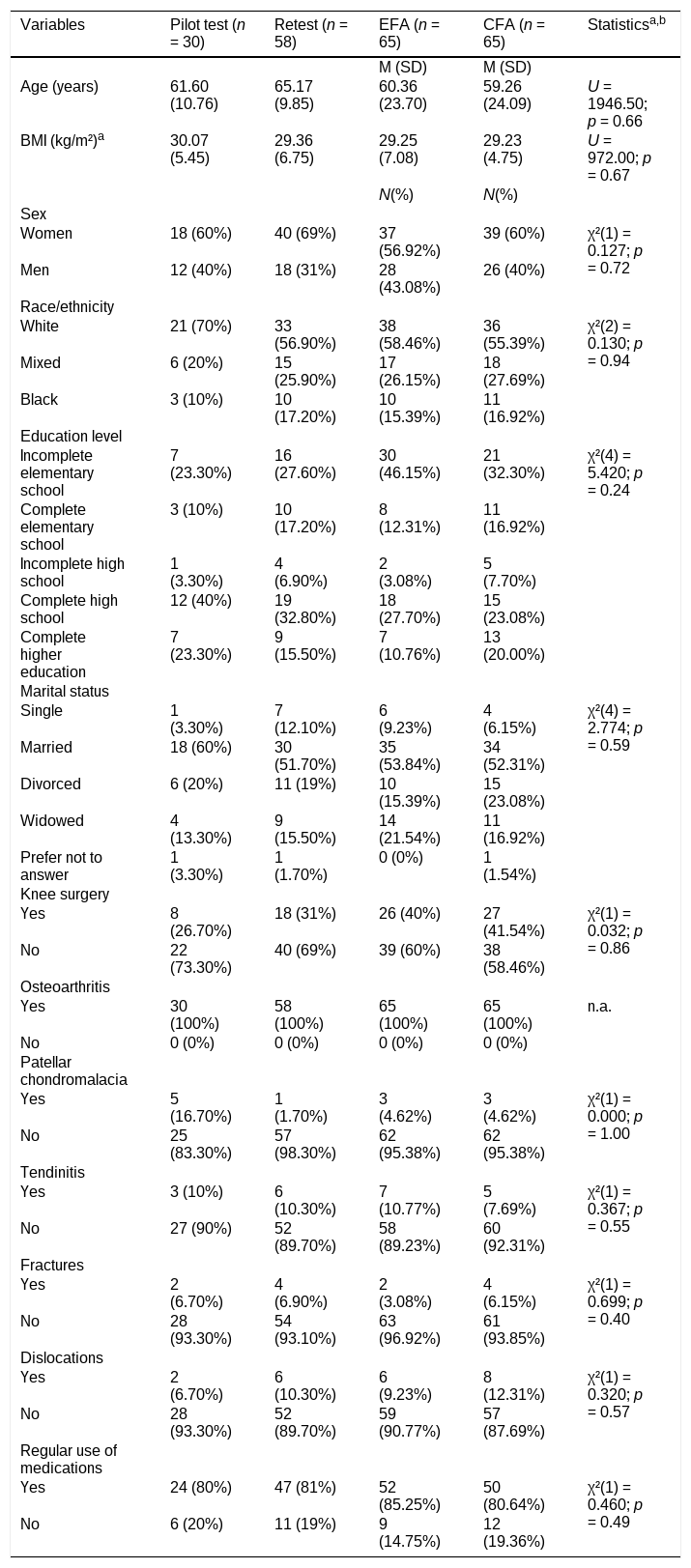
The sociodemographic characteristics of the sample are presented in Table 1. No differences were observed between the sociodemographic data of the first and second subsamples (p > 0.05).
Sociodemographic characteristics of the pilot test, retest, and subsamples from exploratory and confirmatory factor analysis.
| Variables | Pilot test (n = 30) | Retest (n = 58) | EFA (n = 65) | CFA (n = 65) | Statisticsa,b |
|---|---|---|---|---|---|
| M (SD) | M (SD) | ||||
| Age (years) | 61.60 (10.76) | 65.17 (9.85) | 60.36 (23.70) | 59.26 (24.09) | U = 1946.50; p = 0.66 |
| BMI (kg/m²)a | 30.07 (5.45) | 29.36 (6.75) | 29.25 (7.08) | 29.23 (4.75) | U = 972.00; p = 0.67 |
| N(%) | N(%) | ||||
| Sex | |||||
| Women | 18 (60%) | 40 (69%) | 37 (56.92%) | 39 (60%) | χ²(1) = 0.127; p = 0.72 |
| Men | 12 (40%) | 18 (31%) | 28 (43.08%) | 26 (40%) | |
| Race/ethnicity | |||||
| White | 21 (70%) | 33 (56.90%) | 38 (58.46%) | 36 (55.39%) | χ²(2) = 0.130; p = 0.94 |
| Mixed | 6 (20%) | 15 (25.90%) | 17 (26.15%) | 18 (27.69%) | |
| Black | 3 (10%) | 10 (17.20%) | 10 (15.39%) | 11 (16.92%) | |
| Education level | |||||
| Incomplete elementary school | 7 (23.30%) | 16 (27.60%) | 30 (46.15%) | 21 (32.30%) | χ²(4) = 5.420; p = 0.24 |
| Complete elementary school | 3 (10%) | 10 (17.20%) | 8 (12.31%) | 11 (16.92%) | |
| Incomplete high school | 1 (3.30%) | 4 (6.90%) | 2 (3.08%) | 5 (7.70%) | |
| Complete high school | 12 (40%) | 19 (32.80%) | 18 (27.70%) | 15 (23.08%) | |
| Complete higher education | 7 (23.30%) | 9 (15.50%) | 7 (10.76%) | 13 (20.00%) | |
| Marital status | |||||
| Single | 1 (3.30%) | 7 (12.10%) | 6 (9.23%) | 4 (6.15%) | χ²(4) = 2.774; p = 0.59 |
| Married | 18 (60%) | 30 (51.70%) | 35 (53.84%) | 34 (52.31%) | |
| Divorced | 6 (20%) | 11 (19%) | 10 (15.39%) | 15 (23.08%) | |
| Widowed | 4 (13.30%) | 9 (15.50%) | 14 (21.54%) | 11 (16.92%) | |
| Prefer not to answer | 1 (3.30%) | 1 (1.70%) | 0 (0%) | 1 (1.54%) | |
| Knee surgery | |||||
| Yes | 8 (26.70%) | 18 (31%) | 26 (40%) | 27 (41.54%) | χ²(1) = 0.032; p = 0.86 |
| No | 22 (73.30%) | 40 (69%) | 39 (60%) | 38 (58.46%) | |
| Osteoarthritis | |||||
| Yes | 30 (100%) | 58 (100%) | 65 (100%) | 65 (100%) | n.a. |
| No | 0 (0%) | 0 (0%) | 0 (0%) | 0 (0%) | |
| Patellar chondromalacia | |||||
| Yes | 5 (16.70%) | 1 (1.70%) | 3 (4.62%) | 3 (4.62%) | χ²(1) = 0.000; p = 1.00 |
| No | 25 (83.30%) | 57 (98.30%) | 62 (95.38%) | 62 (95.38%) | |
| Tendinitis | |||||
| Yes | 3 (10%) | 6 (10.30%) | 7 (10.77%) | 5 (7.69%) | χ²(1) = 0.367; p = 0.55 |
| No | 27 (90%) | 52 (89.70%) | 58 (89.23%) | 60 (92.31%) | |
| Fractures | |||||
| Yes | 2 (6.70%) | 4 (6.90%) | 2 (3.08%) | 4 (6.15%) | χ²(1) = 0.699; p = 0.40 |
| No | 28 (93.30%) | 54 (93.10%) | 63 (96.92%) | 61 (93.85%) | |
| Dislocations | |||||
| Yes | 2 (6.70%) | 6 (10.30%) | 6 (9.23%) | 8 (12.31%) | χ²(1) = 0.320; p = 0.57 |
| No | 28 (93.30%) | 52 (89.70%) | 59 (90.77%) | 57 (87.69%) | |
| Regular use of medications | |||||
| Yes | 24 (80%) | 47 (81%) | 52 (85.25%) | 50 (80.64%) | χ²(1) = 0.460; p = 0.49 |
| No | 6 (20%) | 11 (19%) | 9 (14.75%) | 12 (19.36%) |
Abbreviations: EFA, exploratory factor analysis; CFA, confirmatory factor analysis; M, mean; SD, standard deviation; BMI, body mass index; N, absolute frequency; %, relative frequency; n.a., non-applicable.
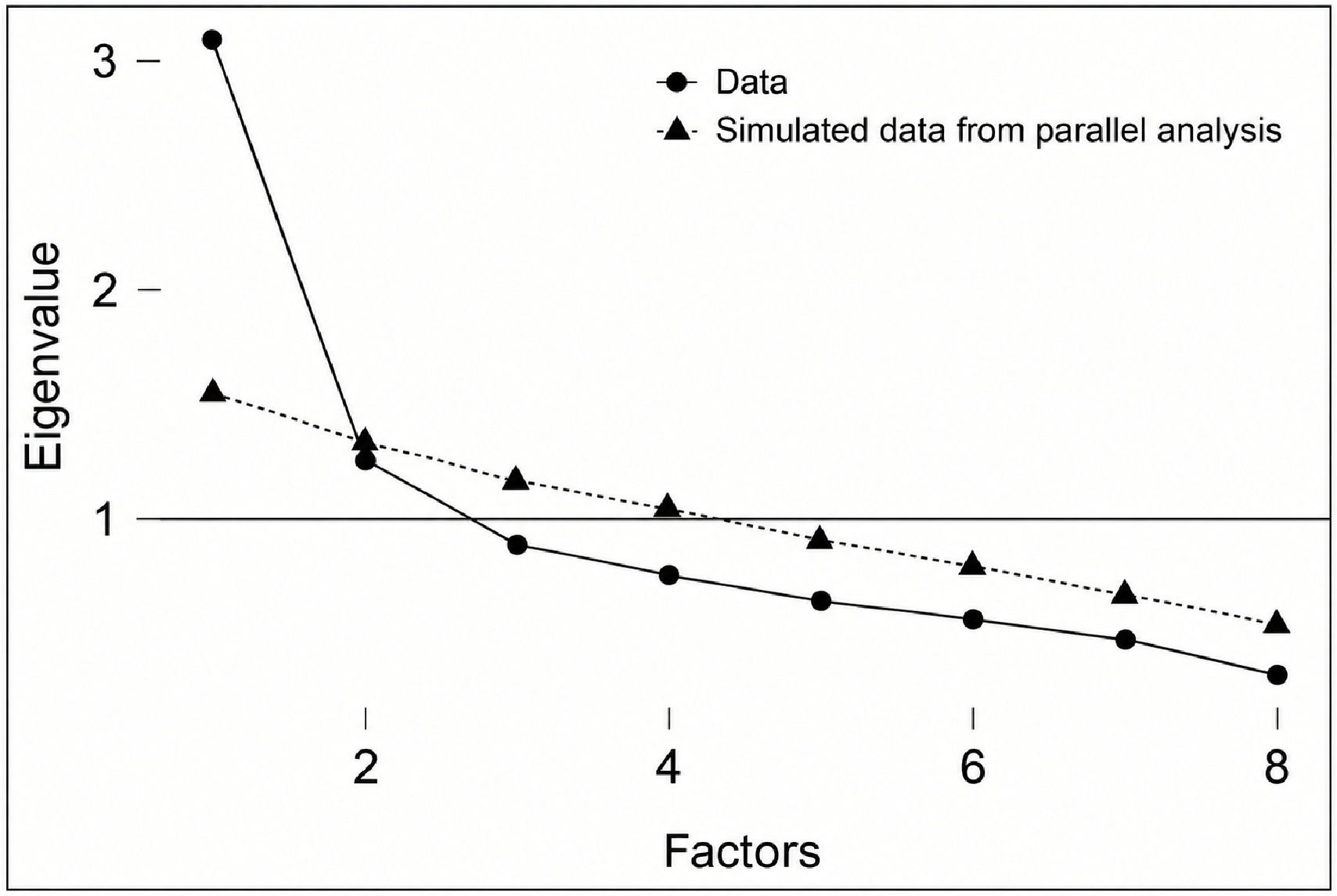
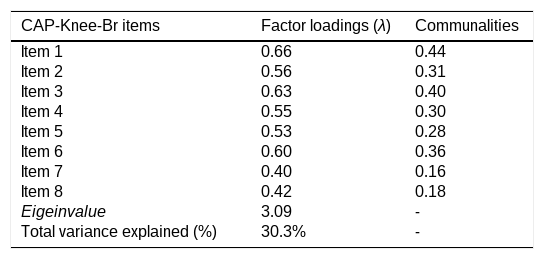
The EFA was first conducted using data from the first subsample (n = 65). The Kaiser-Meyer-Olkin (KMO) measure of sampling adequacy was 0.76, and Bartlett’s test of sphericity was significant (χ² [28] = 116.837; p < 0.001), both indicating that the CAP-Knee-Br items were suitable for EFA. Parallel analysis revealed a unidimensional structure, retaining all eight original items of the CAP-Knee, each with factor loadings greater than 0.40 (λ = 0.40–0.66). The Kaiser criterion suggested the presence of three factors, which contradicted the parallel analysis. However, as shown in the scree plot (Fig. 1), the second factor based on the real data appeared spurious, since the simulated data from the parallel analysis presented higher eigenvalues than the real data.27 Therefore, the unidimensional solution was considered more appropriate. Table 2 presents the factor loadings of each item as well as the total explained variance for the CAP-Knee-Br.

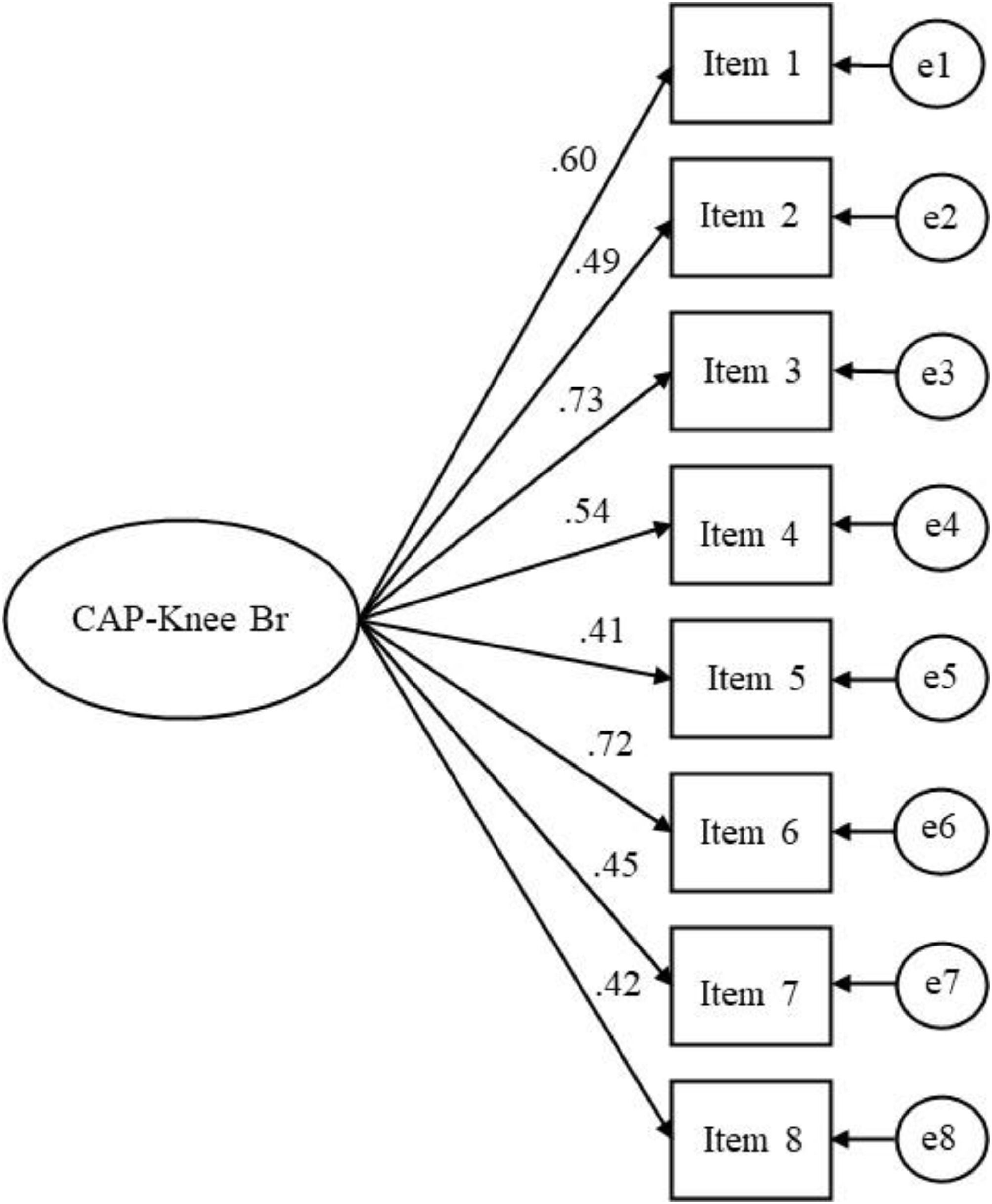
The factor structure of the CAP-Knee-Br was then evaluated through CFA using the second subsample (n = 65). The results indicated adequate fit indices: χ²/df = 0.926 (χ² [20] = 18.528; p = 0.55); CFI = 0.99; TLI = 0.99; RMSEA = 0.000 (90% CI: 0.000, 0.099; p = 0.72), except for the SRMR = 0.087, which was slightly above the cutoff value.25,28 All items presented adequate factor loadings (λ = 0.41–0.73; Fig. 2). Thus, the factor solution obtained in the EFA and confirmed in the CFA was used for subsequent analyses.

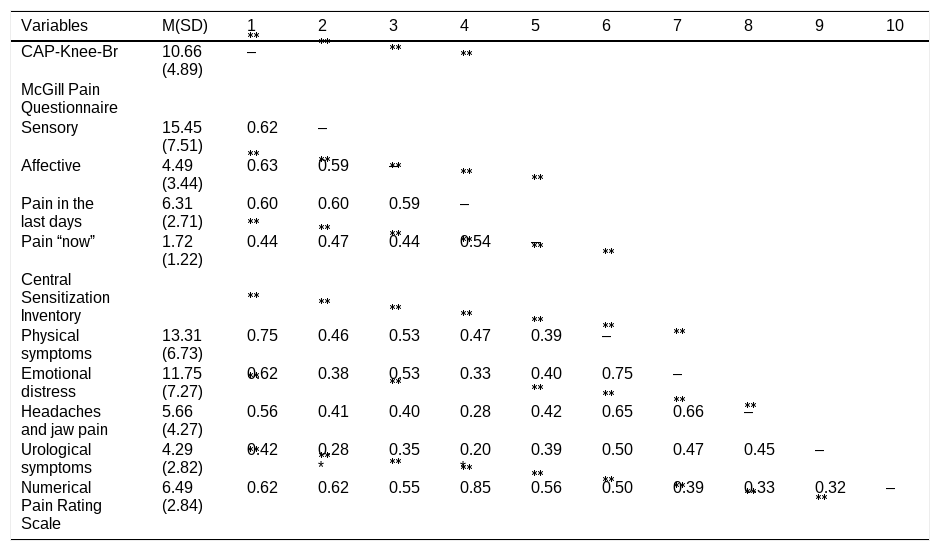
Regarding hypothesis testing (Table 3), the results indicated a positive correlation between CAP-Knee-Br scores and the McGill Pain Questionnaire subscales, the Central Sensitization Inventory subscales, and the Numeric Pain Rating Scale.
Construct validity (hypothesis testing) analysis (Spearman correlation coefficient) of the CAP-Knee (n = 130).
| Variables | M(SD) | 1 | 2 | 3 | 4 | 5 | 6 | 7 | 8 | 9 | 10 |
|---|---|---|---|---|---|---|---|---|---|---|---|
| CAP-Knee-Br | 10.66(4.89) | – | |||||||||
| McGill Pain Questionnaire | |||||||||||
| Sensory | 15.45 (7.51) | 0.62⁎⁎ | – | ||||||||
| Affective | 4.49 (3.44) | 0.63⁎⁎ | 0.59⁎⁎ | – | |||||||
| Pain in the last days | 6.31 (2.71) | 0.60⁎⁎ | 0.60⁎⁎ | 0.59⁎⁎ | – | ||||||
| Pain “now” | 1.72 (1.22) | 0.44⁎⁎ | 0.47⁎⁎ | 0.44⁎⁎ | 0.54⁎⁎ | – | |||||
| Central Sensitization Inventory | |||||||||||
| Physical symptoms | 13.31 (6.73) | 0.75⁎⁎ | 0.46⁎⁎ | 0.53⁎⁎ | 0.47⁎⁎ | 0.39⁎⁎ | – | ||||
| Emotional distress | 11.75 (7.27) | 0.62⁎⁎ | 0.38⁎⁎ | 0.53⁎⁎ | 0.33⁎⁎ | 0.40⁎⁎ | 0.75⁎⁎ | – | |||
| Headaches and jaw pain | 5.66 (4.27) | 0.56⁎⁎ | 0.41⁎⁎ | 0.40⁎⁎ | 0.28⁎⁎ | 0.42⁎⁎ | 0.65⁎⁎ | 0.66⁎⁎ | – | ||
| Urological symptoms | 4.29 (2.82) | 0.42⁎⁎ | 0.28* | 0.35⁎⁎ | 0.20* | 0.39⁎⁎ | 0.50⁎⁎ | 0.47⁎⁎ | 0.45⁎⁎ | – | |
| Numerical Pain Rating Scale | 6.49 (2.84) | 0.62⁎⁎ | 0.62⁎⁎ | 0.55⁎⁎ | 0.85⁎⁎ | 0.56⁎⁎ | 0.50⁎⁎ | 0.39⁎⁎ | 0.33⁎⁎ | 0.32⁎⁎ | – |
Abbreviations: M, mean; SD, standard deviation.
The standard error of measurement was 1.60, the minimal detectable change was 4.43, and the percentage of the standard error of measurement relative to the total CAP-Knee-Br score was 6.67%, classified as good.31 The CAP-Knee-Br questionnaire demonstrated adequate internal consistency, with McDonald’s Omega coefficient of 0.76 (95% CI: 0.69, 0.82). Regarding test-retest reliability, it showed a strong Pearson correlation (r = 0.89; p < 0.001) and a good intraclass correlation coefficient (ICC2,1 = 0.89; 95% CI: 0.84, 0.94). No participant scored the minimum or maximum on the CAP-Knee questionnaire, indicating the absence of floor or ceiling effects, respectively.
DiscussionThe present study aimed to translate and cross-culturally adapt the CAP-Knee questionnaire and evaluate its measurement properties in individuals with knee osteoarthritis. The results indicate that the CAP-Knee-Br demonstrated robust measurement properties. These findings support the applicability of the Brazilian version of this questionnaire in both clinical practice and research.
Construct validity analysis (i.e., structural validity) confirmed the adequacy of the CAP-Knee-Br, making it the first study to examine its latent dimensionality through EFA and CFA; the original version only used CFA.16 The CAP-Knee-Br showed adequate factor loadings, with good total variance explained and excellent fit in the CFA, ensuring its construct validity. In the Japanese version using EFA,36 the eigenvalue > 1 criterion (Kaiser’s criterion) was used, which tends to overestimate factors,25 and is considered arbitrary.37 In both the Japanese study and the present study, this criterion suggested three domains; however, parallel analysis in our study demonstrated that the second factor was spurious, with eigenvalues surpassed by the simulated data,27 confirming unidimensionality as the most appropriate solution for the CAP-Knee-Br. Furthermore, the construct validity (i.e., hypothesis testing) of the CAP-Knee-Br was supported by moderate-to-strong correlations with the McGill Pain Questionnaire subscales, the Central Sensitization Inventory subscales, and the Numerical Pain Rating Scale. These findings corroborate the CAP-Knee’s ability to capture central aspects of pain beyond the nociceptive component, consistent with the biopsychosocial model of chronic pain.38,39
Another relevant aspect was reliability analysis. The standard error of measurement was good, as was the minimal detectable change. The percentage of the standard error of measurement relative to the total CAP-Knee-Br score was classified as good.31 These results indicate good agreement of the instrument and suggest that changes of 5 points or more reflect clinically relevant changes in patient status. The original16 and Japanese36 versions of the CAP-Knee did not report these data, limiting direct comparisons.
Internal consistency and test-retest reliability results were similar to those reported in the original CAP-Knee validation.16 The instrument demonstrated adequate inter-item correlation and temporal stability, evidencing its reliability as a measure for patients with knee pain at different time points. The CAP-Knee-Br showed no floor or ceiling effects, indicating that the questionnaire does not have limitations at the score extremes.
Compared to other instruments commonly used in osteoarthritis, such as the Western Ontario and McMaster Universities Osteoarthritis Index13 and the Knee Injury and Osteoarthritis Outcome Score,14 the CAP-Knee-Br stands out for its approach more aligned with the biopsychosocial model. While the Western Ontario and McMaster Universities Osteoarthritis Index13 and the Knee Injury and Osteoarthritis Outcome Score14 focus on pain and physical function, the CAP-Knee incorporates aspects such as catastrophizing, cognitive impact, and sleep disturbances, making it a more comprehensive instrument for characterizing pain.
Despite these robust findings, this study has some limitations. First, the association between the CAP-Knee-Br and a clinical evaluation of central sensitization, such as Quantitative Sensory Testing,40 was not assessed. Second, the sample was recruited via convenience sampling, which may limit generalizability. Finally, we did not evaluate some measurement properties (e.g., responsiveness).
Future studies should consider larger, more representative samples, including diverse age groups and clinical contexts. Also, they should investigate the responsiveness of the CAP-Knee-Br in clinical trials, assessing its ability to detect changes over time in response to therapeutic interventions.
The adaptation of the CAP-Knee to Brazilian Portuguese addresses a gap in pain assessment among individuals with knee osteoarthritis, enabling more precise evaluation of central pain components. Understanding the underlying mechanisms of musculoskeletal pain, particularly those mediated by central sensitization, can assist in patient stratification and the personalization of therapeutic strategies. Moreover, incorporating the CAP-Knee-Br into future research may contribute to a better understanding of the relationship between chronic pain and psychosocial factors among Brazilian populations, thereby enabling the development of more contextualized clinical guidelines.
ConclusionThe CAP-Knee-Br demonstrated validity and reliability as an instrument for assessing central aspects of pain in individuals with knee osteoarthritis, according to the a priori hypotheses. Its adaptation to the Brazilian context maintains the structure of the original instrument and expands the tools available for chronic pain assessment, enabling a broader approach aligned with the biopsychosocial model of pain.
Data sharing statementData are available upon reasonable request.
FundingThis study was financed in part by the Coordenação de Aperfeiçoamento de Pessoal de Nível Superior – Brasil (CAPES) – Finance Code 001.
The author(s) declared no potential conflicts of interest.
We thank all participants for their valuable contribution to this study.