
The Infant Motor Profile (IMP) evaluates gross and fine motor behavior in infants aged 3–18 months. It offers broad applicability, accessibility, and reliable measurement properties.
ObjectiveTo translate the IMP from British English into Brazilian Portuguese and examine the concurrent validity with the Alberta Infant Motor Scale (AIMS).
MethodsFollowed a five-stage translation protocol (1) authorization, (2) translation, (3) back-translation, (4) final version review, and (5) evaluation. Concurrent validity was assessed in a cross-sectional sample of 120 infants at 4, 6, 10, and 12 months. Spearman's (rho) was applied (5% significance).
ResultsThe translation was completed and approved by one of the IMP's original authors. Weak correlation was observed between the IMP symmetry domain and AIMS total score (rho=0.245, R²=0.06, p-value=0.0069). Moderate correlations emerged between IMP variation (rho=0.525, R²=0.275, p-value=7.64e-10), adaptability (rho=0.571, R²=0.326, p-value=1.89e-06) and fluency (rho=0.622, R²=0.387, p-value=3.36e-14) domains and the AIMS total score. Strong correlations between the performance domain (rho=0.935, R²=0.873, p-value<2e-16) and IMP total score (rho=0.894, R²=0.793, p-value<2e-16) with the AIMS total score.
ConclusionThe Infant Motor Profile was successfully translated into Brazilian Portuguese and presented concurrent validity with AIMS. This research enables the widespread application of an easy, affordable, and validated instrument to assess and early detect infant neurodevelopmental delays or changes in the first months of life. Therefore, Brazilian infants can promptly be referred to appropriate physical therapy interventions.
Early detection and intervention are clinically relevant1 and critical for optimizing infant development, particularly given the intense neuroplasticity in early life.2 It aims to prevent impairments3 and enhance the functionality of infants with diverse health conditions. Effective early detection requires integrating the infant's clinical and developmental history, neurological examination, validated neuromotor assessments, and imaging studies.1 This process is inherently complex, demanding considerable effort to identify individual needs and precisely tailor physiotherapeutic interventions to each infant’s and family’s needs.
Selecting a neuromotor assessment tool that is adequate, sensitive, valid, accessible, and aligned with the ICF framework - addressing body structures and functions, activities, and participation - remains a significant challenge. Commonly used instruments in research include the Alberta Infant Motor Scale (AIMS),4 the Test of Infant Motor Performance (TIMP),5,6 the Bayley Scales of Infant Development (Bayley-III),7 and the Peabody Developmental Motor Scales-Second Edition.3,8,9 Notably, the Infant Motor Profile (IMP)10 has internationally stood out in recent years.
The IMP is a standardized, video-based observational instrument for assessing both spontaneous and elicited fine- and gross-motor behavior in infants from 3 to 18 months of age, or until 3 months post-independent walking. It is administered through guided play-based interaction. The IMP provides a comprehensive evaluation across five domains: Variation, Adaptability, Symmetry, Fluency, and Performance. The first four domains offer a qualitative assessment of motor behavior (e.g., movement repertoire, postural symmetry, movement smoothness), while the Performance domain provides a quantitative measure of motor milestone achievement. These domains are integrated into a total IMP score.10 A core strength of the IMP is its systematic method for standardizing traditionally subjective clinical observations, with all domain and total scores expressed as percentiles for normative comparison.
The IMP outranks for its applicability in typical infants, infants at risk, or those diagnosed with neuromotor disorders.10 It demonstrates robust measurement properties, including moderate-to-high intra- and inter-observer reliability across all domains following brief, standardized training.11–13 Strong construct validity with scores correlating with gestational age, socioeconomic status, 5-minute Apgar scores, and neonatal brain ultrasound findings.14 Concurrent validity of the IMP performance domain and total score with the AIMS total score11; IMP variation, symmetry, fluency, performance domains, and the total score with age-dependent outcomes of the Touwen Infant Neurological Examination (TINE).15 IMP also provides predictive validity for cerebral palsy at 18 months old, analyzing the IMP variation and performance domains,15 and for neurodevelopmental disorders, applying a cut-off point of 70 of the IMP total score at 5 months old.16 Lastly, a responsiveness to changes following a CareToy Program Intervention and Standard Care Intervention.17 Notwithstanding, IMP is a low-cost, accessible instrument requiring only the manual and standard toys. It can be administered in homes, clinics, or educational settings. This makes it an indispensable asset in clinical practice – not only for early diagnosis but also for monitoring therapeutic outcomes, facilitating dialogue with the family, and guiding goal settings. However, the IMP was limited to English.
Most pediatric assessment instruments are developed and available in English. It limits Brazilian researchers and professionals to scarce translated versions with validated measurement properties.18,19 This scenario compromises child health care, since 95% of the Brazilian population does not understand English.20 The scarcity of translated instruments is partly due to the complexity (structured procedures and stages) and high cost of the translation process,21,22,23 which must follow solid guidelines with structured procedures and strict methodological rigor. This process is essential for preserving the validity of the translated instrument.24
Therefore, assessment instruments must be translated and culturally and environmentally adapted to the context in which they are applied.25,26 This process enables effective knowledge translation - encompassing synthesis, dissemination, and exchange of knowledge27 - to bridge research and clinical practice.28–31
Ergo, this study has two aims: (1) to translate the IMP from British English into Brazilian Portuguese. We expect a successful translation of the IMP. The second aim is to examine the concurrent validity of the translated version of the IMP with the AIMS. We hypothesized strong concurrent validity between the IMP performance domain and total score and the AIMS total score.
MethodsThis study adhered to internationally recommended guidelines for instrument translation and measurement properties studies24,32 to ensure a standardized and effective translation of the IMP from British English to Brazilian Portuguese.
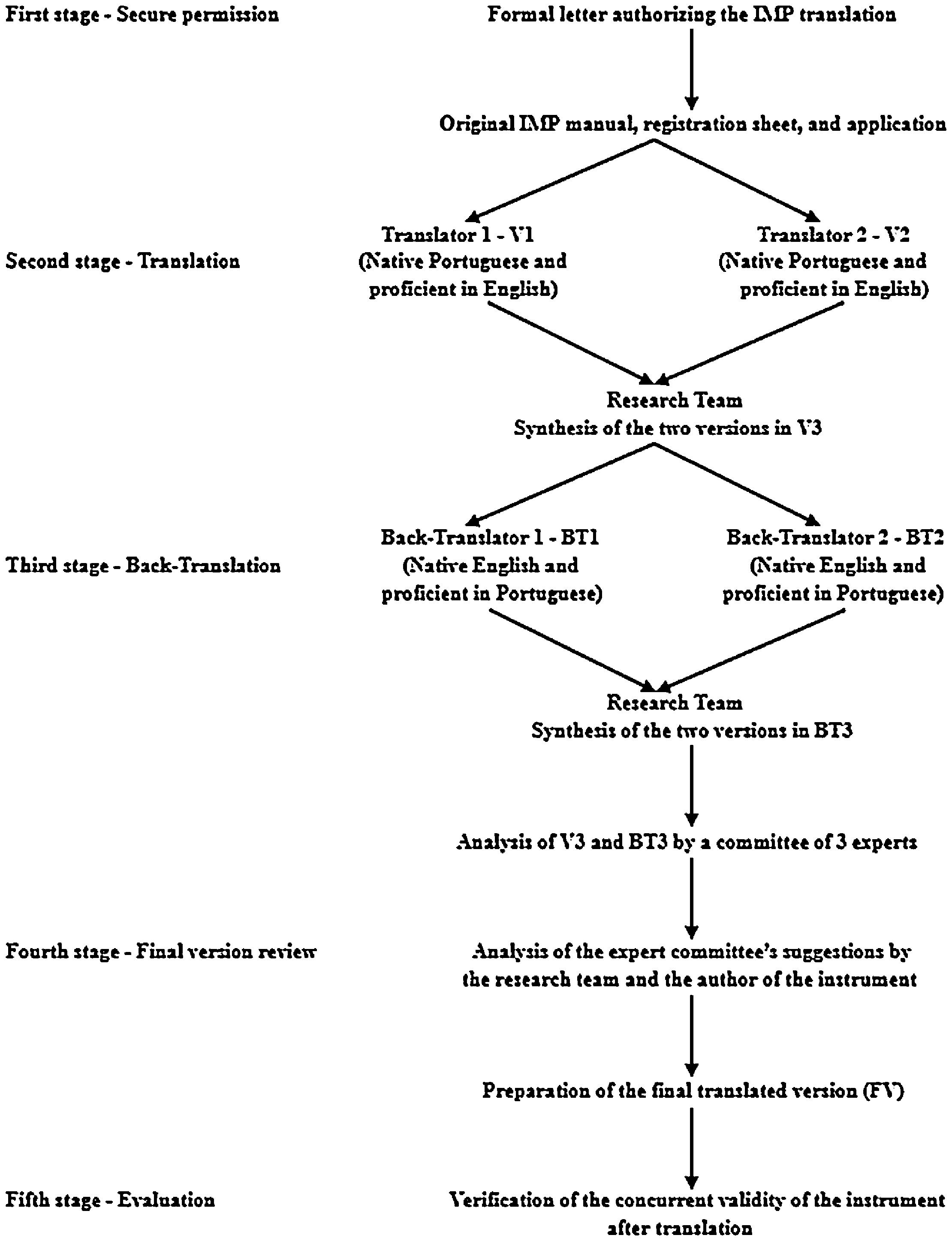
Translation processThe translation process comprised five stages: (1) secure permission, (2) translation, (3) back-translation, (4) final version review, and (5) evaluation21,24 (Fig. 1).

Flowchart of the stages adopted during the translation of the instrument Infant Motor Profile (IMP). The diagram outlines the five-stage methodology for translating the Infant Motor Profile from British English into Brazilian Portuguese. Arrows indicate the sequential and iterative nature of the process, ensuring methodological rigor. IMP = Infant Motor Profile; V1 = version translated by translator 1; V2 = version translated by translator 2; V3 = translated version 3, resulting from synthesis and critical analysis between V1 and V2; BT1 = back-translated version by back-translator 1; BT2 = back-translated version by back-translator 2; BT3 = back-translated version 3, resulting from synthesis and critical analysis between BT1 and BT2; FV = final translated version.
The first stage involved obtaining formal permission from the authors of IMP via a letter (Supplementary Material 1). Additionally, the researchers, Blucher Publishing (Supplementary Material 2), and the Taylor & Francis Group signed a contract that holds the copyright to the IMP manual.
The second stage involved translating the original instrument (Supplementary Material 3) into Brazilian Portuguese. Two bilingual translators - both native Brazilian Portuguese speakers and fluent in English, each one with at least seven years of expertise in physical therapy – independently translated the manual, the recording sheet, and the scoring application.33,34 Thus, two versions of each component were generated (V1 and V2) and analyzed by the research team, which identified discrepancies between them. These were compared with the original materials, and in certain cases, the original authors of the IMP requested further clarification on terms and topics. Finally, the researchers reached consensus, and the third translated version (V3) was developed.
To verify translation accuracy, stage three, the back-translation, was performed. Two bilingual back-translators – both native American English speakers and fluent in Brazilian Portuguese, without expertise in physical therapy, pediatrics, or IMP – independently back-translated the V3 components into English.33,34 Two versions of the IMP manual, recording sheet, and scoring application were generated (BT1 and BT2). These versions were analyzed by the research team to identify disagreements, and after reaching consensus, the third back-translated version (BT3) was developed.
In the fourth stage, V3 and BT3 were compared with the original version of the IMP manual, score sheet, and app by an expert committee of three physiotherapists, experts in the neuropediatric field, each with a minimum of five years of experience. The committee’s suggestions ensure semantic, idiomatic, and conceptual equivalence. The recommendations, along with the versions developed throughout the translation process, were reviewed by the research team in collaboration with one of the original IMP authors, resulting in the final version (FV). The fifth stage involved assessing the measurement properties of the translated instrument. Therefore, the concurrent validity between the IMP and AIMS was verified.
Concurrent validityEthical considerationsThis study was approved by the Human Research Ethics Committee of a Federal University in Brazil, in accordance with Resolution No 510/2016 of the National Health Council and the Declaration of Helsinki. It was registered in the Brazilian Registry of Clinical Trials (ReBEC). Participation requires signing the Informed Consent Form from parents or legal guardians.
ParticipantsSample size calculation was performed using StatsDirect software version 3.0.35 Spearman's (rho) and Pearson's (r) correlation coefficients were considered, assuming 80% power, a 5% alpha, a null correlation coefficient of 0, and an alternative correlation coefficient of 0.56. The last was based on the results found by Heineman and colleagues11 regarding the correlation between the IMP performance domain and the AIMS total score. A minimum of 24 infants per age group was required, resulting in a total sample size of 96. A 20% increase in sample size was added to account for potential loss, yielding a final sample size of 116 infants.
A cross-sectional cohort of 120 infants (30 infants per age group) was assessed at four stages: 4, 6, 10, and 12 months (chronological or corrected age). Inclusion required parental consent. Exclusion criteria comprised: (1) a clinical diagnosis of an established health condition, which resonates in body structure/function impairments, activity limitations, and/or participation restrictions; (2) parents and/or legal guardians with insufficient comprehension of Portuguese or residency in Brazil for less than five years. Participants were recruited via primary healthcare centers and targeted social media publications.
AssessmentMotor behavior was assessed concurrently using the IMP and the AIMS to establish concurrent validity. The AIMS was selected as the criterion measure based on its established concurrent validity with the IMP in the original English-language validation studies.11,15
The IMP is a standardized observational instrument that provides a combined quantitative and qualitative assessment of gross and fine motor behavior in infants from 3 to 18 months of age, or until three months after the acquisition of mature independent walking.10 Its validity extends to both typically developing infants and those with atypical development or established neurodisability.10,11,15,16,36 The assessment is performed via guided play in four key positions: supine, prone, sitting (on floor and caregiver's lap), and standing. In each situation, the researcher elicits spontaneous activities including play, transitions, and locomotion. Fine motor skills are evaluated during reaching, grasping, and toy manipulation. The instrument comprises 80 items organized into five domains: (1) Variation (25 items) - measures the size of the infant's motor repertoire (primary variability); a restricted repertoire indicates a high risk for neurodevelopmental disorders. (2) Adaptability (15 items) - assesses the ability to select optimal motor strategies for specific tasks (secondary variability); linked to motor learning and predictive of later cognitive function. (3) Symmetry (10 items) - detects postural and movement asymmetries; persistent, significant asymmetry may suggest unilateral neurological impairment. (4) Fluency (7 items) - rates smoothness, elegance, and effortlessness of movement; persistently low fluency scores warrant further neurological investigation. (5) Performance (23 items) - quantifies motor milestone achievement, serving as a direct parameter of neuromotor development.10 These domains are theoretically grounded in the Neural Group Selection Theory (NGST). Domain scores and IMP total scores are calculated and expressed as percentiles. Clinically, scores are interpreted categorically (e.g., typical/atypical variation, adequate/low fluency, presence of asymmetry, and total scores classified as very low, low, or adequate), facilitating direct clinical decision-making.¹⁰
The AIMS is an observational scale that assesses gross motor development in full-term and preterm infants from birth to 18 months, or until independent walking.4 It consists of 58 items across four postural subscales: prone (21 items); supine (9 items); sitting (12 items); and standing (16 items). Scoring is based on observation of the infant's performance - weight bearing, posture, and antigravity movements.4,37,38 Items observed are marked as 'O', and those not observed as 'NO'. Attention should be paid to the most immature and most mature items observed during the assessment – the infant's motor window in each posture. Each items within and below the motor window receive a score of 1. Subscale scores are summed to yield a total raw score, which was used in this study. This score can be converted to percentiles using the reference curve from Canadian infants in Alberta province.4,37,38 Infants scoring below the 10th percentile at four months and/or the 5th percentile at eight months were considered to have motor development delay.39
ProceduresAssessments were scheduled according to family availability and preference, to be conducted either at home or in a university laboratory.
At the time of assessment, infants wore only diapers and were required to be in an appropriate alert behavioral state, state 3 (eyes open, minor movements) or state 4 (eyes open, major movements, but not crying),40 as state significantly influences neurodevelopmental assessments.41 If the infant’s alertness changed, the assessment was interrupted to allow the caregiver to soothe the infant. If an appropriate state was not regained, the session was rescheduled within two days.
Following parental consent and collection of sociodemographic data, the infant was positioned on a mat. A video camera, mounted on a tripod, recorded the entire session. A single researcher simultaneously administered both the IMP and AIMS, eliciting motor skills through guided play. Assessments were conducted by four independent pediatric physiotherapists across three states (Minas Gerais, São Paulo, and Mato Grosso do Sul). All assessors possessed at least 2 years of clinical experience in neuropediatrics and specific training in both instruments. Each had completed standardized training by certified primary researchers, covering administration, camera setup, and video quality standards.
Video scoring was conducted independently under blind conditions. The IMP videos were scored by four researchers, and the AIMS videos were scored by two researchers. A strict protocol ensured that no researcher scored both the IMP and AIMS for the same infant. All researchers had at least 2 years of experience in neuropediatric/early detection, familiarity with the instruments, and demonstrated moderate to strong inter-rater reliability in prior calibration (Cronbach’s alpha ≥ 0.90; ICC ≥ 0.80; across rates Cronbach’s alpha ≥0.74).42,43,44
Data analysisStatistical analysis and graphical representations were conducted using R software, native cor() function,45 and ggplot2 package,46 respectively. Descriptive statistics were used to characterize the sample. Concurrent validity between the IMP and AIMS instruments was tested for the total sample and stratified by age group using Spearman's correlation coefficient (rho) and the coefficient of determination (R²), given that Spearman’s rho is a nonparametric measure that does not require data normality and is relatively robust to outliers and heteroscedasticity. Only correlations with p-value <0.05 were interpreted; they were classified as follows: weak (rho=0.00–0.25), fair (rho=0.26–0.50), moderate (rho=0.51–0.75), and strong (rho>0.75).47 The coefficients of determination were interpreted as insignificant (<0.10), weak (0.10–0.39), moderate (0.40–0.69), strong (0.70–0.89), and very strong (0.90–1.00).48
ResultsTranslationAfter a detailed analysis of the translated IMP manual and other components, along with discussions with one of the instrument's original authors, the research team concluded that a formal cross-cultural adaptation of the instrument was not required. This decision was based on two key factors: (1) the materials and toys used in the original version are accessible in the Brazilian context, and (2) the items do not involve culturally specific skills or activities related to modes of individual participation, such as specific sport tasks. Therefore, a direct translation into Portuguese was performed, preserving the original structure, terminology, and scoring criteria.
During the translation of the IMP instrument, discrepancies were observed between the versions prepared by the translators (stage 2) and the back-translators (stage 3). Only minimal discrepancies were noted between the final version (FV) and the original material (stage 4). These minor differences were discussed and resolved by consensus of the research team and the original IMP author, ensuring conceptual and semantic equivalence across versions.
Regarding stage 2 – translation, some inconsistencies were identified between V1 and V2 in grammar (use of pronouns, articles, and textual cohesion) and in the technical terms used. These discrepancies were reviewed and discussed by the research team to ensure clarity in Portuguese, maintain technical accuracy, and ensure consistency with the content of the original IMP components, resulting in V3. This was also observed and implemented during stage 3 – back-translation. The discussion surrounding the discrepancies leads to the production of the refined back-translated version (BT3).
In stage 4, one of the IMP authors, in collaboration with the research team, analyzed the original version (V3) and BT3 of the IMP. Discrepancies were primarily related to formatting and the presentation of specific terms. For instance, the term "em bloco" (en bloc) was enclosed in quotation marks to highlight its technical nature; while the term toddling - after being defined at first mention - was presented in English and italicized throughout the text. All discrepancies were discussed and resolved by consensus, resulting in the final translated version (FV), including the final translated version of the IMP scoresheet (Supplementary Material 4).
Therefore, the translation of the IMP from British English into Brazilian Portuguese was successfully completed. It was confirmed by one of the IMP's original authors during stage 4 and further supported by concurrent validity analyses comparing the translated version of the IMP with the AIMS, as described in stage 5 below.
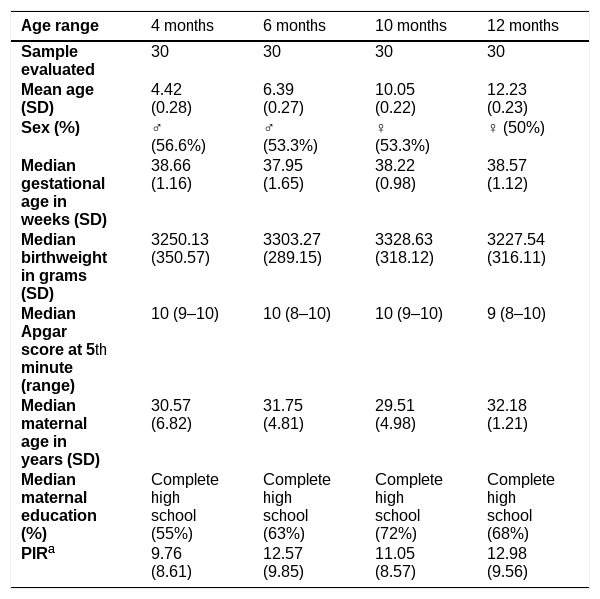
Concurrent validityA total of 120 infants (51.6% male) participated in this cross-sectional study. The sample was stratified by age, with 30 infants in each of the following age groups: 4, 6, 10, and 12 months (Table 1). Participants resided in three cities across three Brazilian states (Minas Gerais, São Paulo, and Mato Grosso do Sul). The four assessors who applied the IMP and lived in these different states completed the IMP theoretical–practical training course and were trained by the certified study coordinators, including instruction on proper administration, camera positioning, and video quality requirements in accordance with the IMP manual.
Sample characteristics.
Table presents descriptive results for key perinatal and sociodemographic characteristics of the sample. As perinatal characteristics, we described sex, gestational age (weeks), birth weight (grams), and Apgar score at 5 min. Regarding sociodemographic characteristics, the table presents values for maternal age (years), maternal education, and the Poverty Income Ratio. a Ratio between family income and poverty level by geographic area (Karlamangla et al., 2010; Zare et al., 2022). According to Article 18 of Decree No 9396 of 2018, the poverty line in Brazil was 178.00 per person per month (Brasil, 2018). SD = standard deviation; % = percentage; 5th = fifth; PIR = Poverty Income Ratio; ♂ = male; ♀ = female.
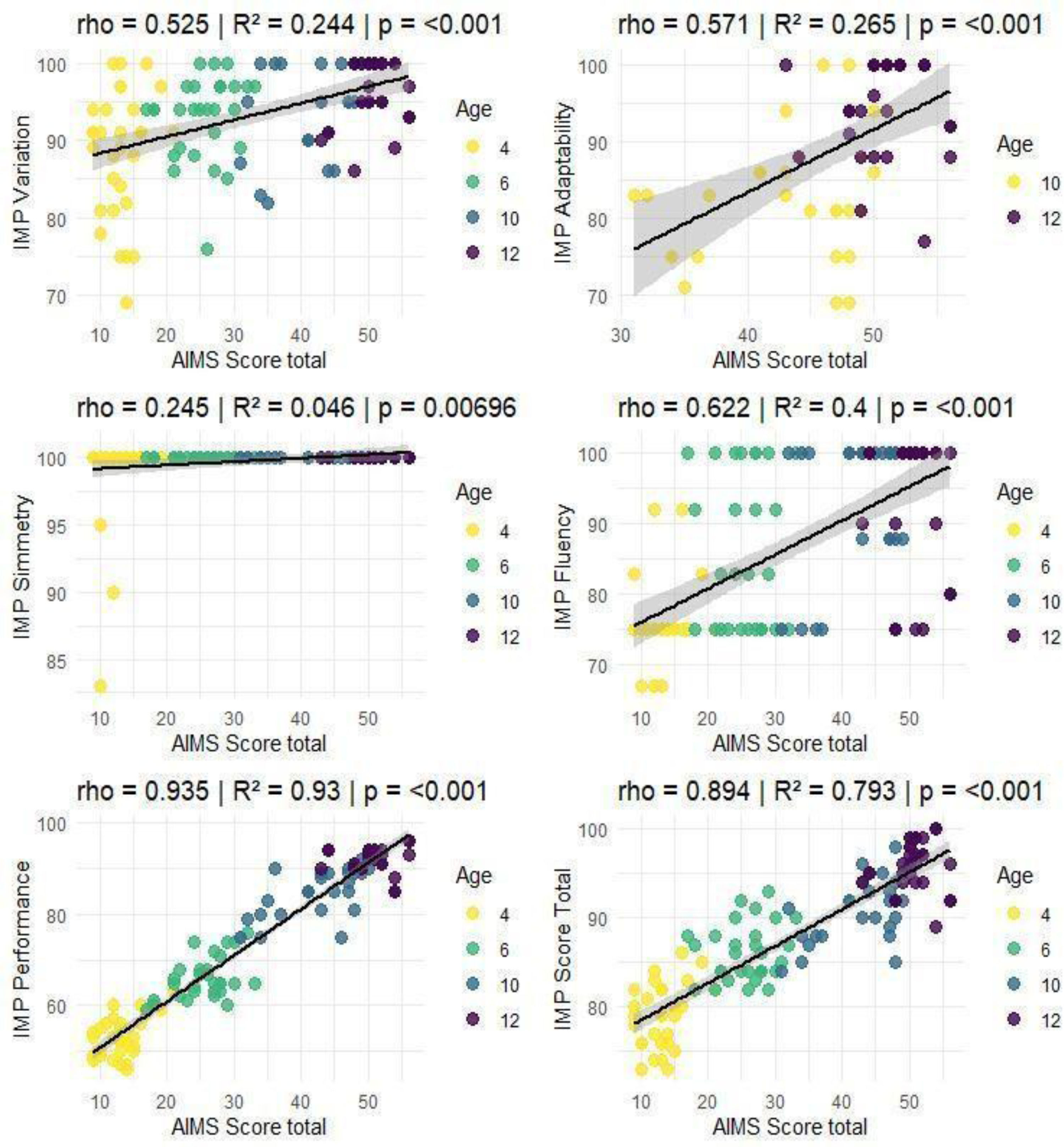
When analyzing the full sample, correlations between the instruments were found to be even more robust. A weak but statistically significant correlation was observed between the IMP symmetry domain and the AIMS total raw score (rho=0.245, R²=0.06, p = 0.0069), which is expected, as symmetry reflects left–right alignment and the AIMS does not systematically rate asymmetry. Moderate and statistically significant correlations were observed between the IMP variation domain (rho=0.525, R²=0.275, p = 7.64e-10), the adaptability domain (rho=0.571, R²=0.326, p = 1.89e-06), and the fluency domain (rho=0.622, R²=0.387, p = 3.36e-14) with the AIMS total raw score, suggesting partial overlap between milestone skills (AIMS) and qualitative motor behaviour (IMP). Furthermore, strong and statistically significant correlations between the performance domain (rho=0.935, R²=0.873, p < 2e-16) and the IMP total score (rho=0.894, R²=0.793, p < 2e-16) with the AIMS raw total score, which is expected because both instruments capture gross motor performance, especially milestone skills. The ages assessed (4, 6, 10, and 12 months) also include phases of rapid motor skill acquisition, especially between 10 and 12 months, when infants typically gain sitting stability, transitions, standing, and early locomotion, which strongly influence performance and milestone skills (Fig. 2).

Dispersion of data regarding concurrent validity between the Infant Motor Profile (IMP) and Alberta Infant Motor Scale (AIMS) instruments. Each panel displays the relationship between scores from a specific IMP domain and the AIMS total score for 120 infants (30 infants per age group) assessed at four ages: 4 (yellow), 6 (green), 10 (blue), and 12 (purple) months of age. Data distribution is color-coded by age using the viridis palette. Note that the adaptability domain does not present scores for infants aged four and six months, due to specific developmental requirements inherent to the IMP instrument. Key statistical results for the overall correlation within each domain are annotated on the respective plots. AIMS = Alberta Infant Motor Scale; IMP = Infant Motor Profile; rho = Spearman’s rank correlation coefficient; R2 = Adjusted R-squared; p = p-value.
Several studies highlighted the importance and effectiveness of the IMP for the diagnosis and monitoring of neuromotor disorders.11,15,36,49,50 However, in Brazil, this instrument had only been applied in two studies using the original English version.49,50 Linguistic, cultural, social, and contextual differences – including technological development and values - between the countries of origin and the target may impact the reception of the instrument, interfering with its validity and reliability. These factors may affect assessment procedures, scoring accuracy, and interpretation of the results.51 Silva and colleagues49 were aware of this. They adopted precautionary strategies such as conducting training courses, calibrating assessors, and establishing an agreement index with the translation team and one of the IMP's original authors.
This study successfully translated the IMP instrument from British English into Brazilian Portuguese, rigorously adhering to internationally established stages and guidelines for instrument translation studies.21,24 Throughout the process, specific adjustments were made to enhance linguistic clarity and technical precision, including refining terminology and replacing certain expressions. Nevertheless, these adaptations remained faithful to the original conceptual and semantic content of the material, as confirmed by one of the IMP original authors during stage 4 of this study.
As hypothesized, strong concurrent validity was confirmed between the translated IMP and AIMS. Analysis of 120 infants at four, six, ten, and 12 months revealed strong correlations for the IMP performance domain (rho=0.935, R²=0.873, p-value<2e-16) and IMP total score (rho=0.894, R²=0.793, p-value<2e-16) with AIMS total score. These results align with the study of Heineman et al.,11 reported robust correlations for the performance domain (rho=0.84, p-value<0.01) and IMP total score (rho=0.54, p-value<0.01) with AIMS total score in a mixed sample of preterm and term typical infants up to 18 months. Similarly, Rizzi et al.15 found strong validity for term and preterm infants at five months for IMP performance domain (rho=0.89, p-value<0.001), IMP total score (rho=0.76, p-value<0.001) with AIMS total score. The strength of these associations stems from the shared construct of achievement of gross motor milestones, assessed through these scores.10,11,15 The correlation was not absolute, reflecting IMP’s additional assessment of fine motor behavior not captured by the AIMS. Critically, the magnitude and pattern of these correlations match those reported in the literature,14,15 reinforcing that the translation process successfully preserved the core measurement properties of IMP.
Moreover, moderate correlations were observed between the AIMS total score and IMP domains of variation and adaptability. The age groups assessed in this study correspond to periods of intense motor skill acquisition, exploration of movement combinations, and selection of the optimal motor strategies. These aspects are reflected in neuromotor development and are captured by both AIMS and IMP scales. In contrast to previous studies,11,15 we found a moderate correlation between the IMP fluency domain and the AIMS total score. This may reflect the parallel development and expansion of motor repertoire, the strategy refinement, and the improvement of postural control over time, which occur concomitantly with the improvement of postural and movement control, as evidenced by the IMP fluency domain.52
Lastly, the symmetry domain demonstrated only a weak correlation with the AIMS total score (rho=0.245, R²=0.06, p-value=0.0069). This was anticipated, as the AIMS does not systematically assess symmetries (e.g., it does not require bilateral motor skills).37 The symmetry scores remained high and stable, which aligns with established neurodevelopmental principles. Postural and movement symmetry are expected at birth, as subcortical and sensorimotor networks, thalamocortical connections, and cerebellar projections exhibit a bilaterally symmetric topological organization from birth.53–56 Consequently, in the absence of a unilateral neurological lesion, postural and movement symmetry is a foundational characteristic of typical neuromotor development in the first years.
It is important to emphasize that the generalizability of this study’s findings is subject to certain limitations. The sample was recruited from only three of Brazil's 26 states, potentially underrepresenting the full spectrum of its diverse infant motor experiences, cultural, and socioeconomic contexts. Therefore, normative data representative of the Brazilian population is presented in another study. The cross-sectional design provides a snapshot of age-based motor skills development, but cannot model intra-individual growth curves. Nevertheless, this study represents a critical advance for clinical practice in Brazil. It enables healthcare professionals a validated, population-specific tool to identify motor atypicality with greater precision, moving beyond reliance on international standards. This work supports early detection of motor development disorders and tailored physical therapy interventions; it also serves as a foundation for future longitudinal and region-specific research with Brazilian infants.
ConclusionThe IMP was successfully translated into Brazilian Portuguese, as evidenced by the methodological rigor adopted throughout all stages of the translation process, the approval by an expert committee and one of the original IMP authors, and the maintenance of concurrent validity with the AIMS, as reported in previous studies. The IMP is a comprehensive instrument for assessing neuromotor behavior, with essential relevance to scientific and clinical settings. Aligned with the biopsychosocial model, it enables evaluation of infants' body structures, functions, and activities and possesses robust measurement properties. The availability of the translated version of the IMP facilitates widespread use of a promising instrument among Brazilian healthcare professionals, enabling early detection of developmental delays or alterations in the first months of life by assessing gross and fine motor skills. Therefore, this study offers a detailed, comprehensive instrument that enhances infant neuromotor assessment for researchers and health professionals and supports the optimization of early intervention tailored to individual needs.
FundingThis work was supported by the São Paulo Research Foundation (FAPESP), grant number 2020/14904–2; 2020/11267–1; #2023/00574–9).
Declaration of generative AI and AI-assisted technologies in the writing processNone.
The author(s) declared no potential conflicts of interest.
The authors would like to thank the infants' legal guardians for their willingness to evaluate and participate in this study. They also thank Professor Dr. Mijna Hadders-Algra, a pediatric neurologist and author of the IMP, for her collaboration in stages 1 and 4 of the translation process. In addition, we would like to thank Professor Dr. Jaqueline da Silva Frônio for her collaboration in stages 1 to 4 of the translation process. Authors also acknowledge the São Paulo Research Foundation (FAPESP).