To evaluate the measurement properties of the Brazilian version of the Chelsea Critical Care Physical Assessment Tool (CPAx-Br) and evaluate the evidence of validity in adult general ward patients, extending its application beyond the critical care setting for which it was originally developed.
MethodsThis longitudinal study included 100 adults (57.5 ± 16.7 years; 54% female) consecutively admitted to hospital wards. The CPAx-Br was applied at three time points: within 48 h of admission, alongside the De Morton Mobility Index (DEMMI) and the Global Rating Scale of Change (GRC); 24 h later to assess reliability; and at hospital discharge, again with the DEMMI and GRC. As part of construct validity, hypothesis testing was performed using Spearman's correlation with the DEMMI. Reliability was tested using the Intraclass Correlation Coefficient (ICC2,1) and Standard Error of Measurement (SEM). Responsiveness was evaluated using ROC curve analysis, effect size (ES), and correlation with external measures. Floor and ceiling effects were also examined.
ResultsThe CPAx-Br demonstrated adequate reliability (ICC2,1 = 0.99; 95%CI:0.99–1.00) and measurement error (SEM=0.985). Evidence supporting construct validity was obtained through hypothesis testing, demonstrating a positive correlation with the DEMMI (r = 0.895; p < 0.001). Internal responsiveness was low (ES=0.35), while external met the predefined criterion (r = 0.70; p < 0.001). The CPAx-Br showed acceptable discriminative ability (AUC=0.70; 95% CI 0.54 to 0.85), with no floor effect (0%), whereas the ceiling effect was 16%.
ConclusionThe CPAx-Br demonstrated validity based on hypothesis testing, as well as good reliability and acceptable responsiveness for assessing physical function among adult ward patients.
One of the most important strategies for managing physical-functional complications associated with hospitalization is implementing standardized patient assessment. To carry out these standardized assessments, instruments with adequate measurement properties should be prioritized.1 Such instruments facilitate interprofessional communication and promote a functional description of the individual throughout the hospital stay.2 Due to the recognition of the need to use these instruments in clinical practice, several instruments in clinical practice, several instruments have been developed to assess physical and functional conditions in hospitalized patients. However, most of them have been focused on and validated only for use in intensive care.3
Considering that ICU-acquired disorders require continued rehabilitation in the ward, and that these physical-functional disorders also occur in patients hospitalized directly in the ward, instruments developed for this environment are also necessary.4 In this sense, the only instrument specifically focused on ward-acquired patients is the De Morton Mobility Index (DEMMI).5 However, it was developed for the functional assessment of older patients.
In the search for instruments not restricted to older inpatients and potentially suitable for validation in general ward patients, the Chelsea Critical Care Physical Assessment Tool (CPAx) stands out. CPAx encompasses functional aspects based on the International Classification of Functioning, Disability and Health (ICF), and uniquely combines assessments of respiratory function, mobility, and objectively measured muscle strength.6,7 The CPAx developers emphasize that physiotherapists in Europe, as well as in other places in the world, are responsible for both respiratory therapy and motor rehabilitation.
Developed in London (UK) in 2009, the CPAx was designed to address the need for a more comprehensive assessment tool capturing the full scope of physical-functional limitations in critically ill patients.6 Later, CPAx was translated and validated into Spanish.8 Danish (CPAx-D).9 Swedish (CPAx-Swe).10 Chinese (CPAx-Chi).11 German (CPAx-GE).12 Norwegian (CPAx-NOR).13 European Portuguese (Portugal).14 and Brazilian Portuguese (CPAx-Br).15 In all versions, CPAx has been validated for patients in intensive care and presented adequate properties of measurement. Therefore, this study aimed to evaluate the inter-rater reliability, measurement error, construct validity (hypothesis testing), and responsiveness, as well as the ceiling and floor effects of the CPAx when applied to adult patients admitted to general hospital wards.
MethodsThis longitudinal methodological study to evaluate measurement properties followed the recommendations of the Guidelines for Reporting Reliability and Agreement Studies (GRRAS).16 and the Consensus-based Standards for the Selection of Health Measurement Instruments (COSMIN).17 The research began after approval by the Research Ethics Committee (CAAE 73992423.7.0000.5501), and all participants signed the Informed Consent Form.
ParticipantsIn accordance with criteria established by COSMIN.17 100 volunteers consecutively hospitalized in the wards were included.
Inclusion criteria: aged 18 years or older, hospitalization in the ward within the last 48 h, expected to remain hospitalized in the ward for at least 72 h, and without a prescription for bed rest. Being able to handle the cognitive and memory demands that assessments require.
Exclusion criteria: need for intensive care or surgical procedures, presenting any clinical instability between the test and retest, death, or hospital discharge between the test and retest.
ProcedureBefore data collection began, the team of examining physiotherapists was trained in and conducted pilot assessments, the results of which were not included in the study.
Data collection was conducted in the clinical wards of a university hospital, which exclusively treats low- and medium-complexity cases. All assessments took place at the same time of day and were always conducted at the patient's bedside.
Assessments were performed at three time points: V1 – up to 48 h after admission to the ward (test), V2 – 6 to 24 h after the first assessment (retest), and V3 – up to 24 h before hospital discharge. V1 was administered by examiner A, together with the scales CPAx-Br, DEMMI, and GRC (Global Rating Scale of Changing). In V2, examiner B administered the CPAx-Br and GRC scales independently and in a blinded manner to the initial results. V3 was administered by either examiner up to 24 h before hospital discharge using the CPAx-Br, DEMMI, and GRC scales.
InstrumentsChelsea Critical Care Physical Assessment Tool (CPAx): Consists of commonly used aspects for assessing physical ability globally, including respiratory function, cough, mobility, balance, and muscle strength. It has 10 items without subclassifications; each scored from 0 to 5 according to the patient's level of dependence. For each of the six levels, the components are described for assessment purposes. There is no published instruction manual for the scale. The component scores are summed at the end, with 0 indicating complete dependence and 50 indicating complete independence.6,7
The last component of the scale is based on handgrip strength (HGS), measured using a handgrip dynamometer. This component was assessed using a single, previously calibrated handgrip dynamometer, following a protocol developed by the researchers, as there is no specific protocol for the scale.18–20 HGS was assessed three times on the dominant hand, according to the patient's report, and the average score was used for analysis.20 In cases where the participant was unable to sit, the positioning was adapted to the best possible posture within the protocol (supine position with elbow flexion and, as a last resort, supine position with elbow extension). To determine the score, the obtained value was cross-referenced with a reference table provided by the original instrument.21
De Morton Mobility Index (DEMMI): This instrument was chosen as a comparator because it assesses the same construct as the target instrument and has been validated in Brazilian Portuguese specifically for hospitalized patients in the ward. Its measurement properties have been tested and found to be appropriate for this population.22
The DEMMI assesses 15 activities subdivided into five groups: activities in bed, in a chair, walking, static and dynamic balance. In the present study, assessments followed the guidelines in the instrument manual, based on patient performance and the level of assistance required. Each activity proposed by the scale receives a score ranging from 0 to 2 or from 0 to 1. The raw score is obtained by summing all items (ranging from 0 to 19 points) and subsequently converted to a scale-specific score ranging from 0 to 100, with higher scores indicating greater mobility.8,22
Global Rating of Change (GRC) Scale: Since this study also aimed to analyze CPAx-Br's ability to detect patients' clinical change over time, the GRC scale was administered to compare variation in scale scores with participants' own perceptions of changes in their physical function. Thus, the following question was asked: "Regarding your general movement, how would you describe yourself now compared to the first day of your hospitalization—worse, the same, or better?" If the answer was "worse" or "better," a second question was asked to understand the magnitude of the difference on a 5-point scale. According to this protocol, the assessment scale ranged from −5 (much worse) to +5 (much better).23,24
Measurement propertiesThe CPAx can be considered a formative instrument, and therefore, structural validity and internal consistency were not tested, following the COSMIN recommendations.17 Criterion Validity was also not assessed, as there are no gold-standard instruments for assessing physical function in hospitalized patients.
Therefore, the following measurement properties were tested: Inter-rater Reliability, Measurement Error, Construct Validity (hypothesis testing), Responsiveness, and Ceiling and Floor Effects.25
Inter-rater Reliability: Investigates whether scores given to patients who did not show clinical changes remain consistent in repeated measurements by different evaluators.17,26,27 To assess this property, the scores from V1 and V2 were used. Before the second administration, the clinical stability of the participants was ensured by reviewing medical records and patient assessments. The researchers defined a 24 h interval to ensure that hospitalization did not pose a risk of clinical-functional change between assessments and to minimize participant recall bias.
Measurement Error: Measures how well patients can be distinguished from one another, accounting for the instrument's systematic error.17
Construct Validity (hypothesis testing): Measures the instrument's ability to assess its intended construct. It is determined by its performance in assessing the construct relative to another comparative instrument.17 The hypothesis was formulated prior to data collection, and a moderate to strong positive correlation was expected when compared to the DEMMI scale.
Floor and Ceiling effect: Although not considered a measurement property, interpretability was also analyzed in this study using the floor and ceiling effects. The ceiling effect occurs when tasks are too easy for the study population, resulting in a high number of participants with maximum scores. Conversely, the floor effect is observed when tasks are too difficult, leading to a high number of participants with minimum scores. Both were assessed to determine whether the instrument could differentiate participants across different clinical situations.17
Responsiveness: It checks the instrument's ability to detect clinical changes over time, even if they are subtle. Responsiveness was analyzed based on the patient's physical function. Responsiveness is assessed by the internal variation of the score on the target instrument, the variation in external comparisons with another instrument, and the patient's perception of change.17
Statistical analysisInter-rater reliability was analyzed using the Intraclass Correlation Coefficient (ICC) and respective 95% confidence intervals (95%CI), where the effects of the raters and the item are considered random, and the differences between raters are considered consistent because they are systematic (ICC2.1). Values below 0.40 were considered low, between 0.40 and 0.75 moderate, from 0.76 to 0.90 substantial, and greater than 0.90 excellent.26
Measurement Error was calculated using the standard error of measurement (SEM) by dividing the standard deviation of the difference between the scores of the first two administrations by the square root of 2. Minimal detectable difference (MDD) was calculated by dividing the difference in test and retest scores by the square root of (2 x SEM x 1.64).28 The classification adopted was very good (less than 5%), good (5% to 10%), doubtful (between 10% and 20%), and negative (greater than 20%).26 Hypothesis testing for construct validity was performed using Spearman's correlation coefficient to assess the correlation between the total DEMMI scale score and the CPAx-Br score. The correlation was classified as weak if r < 0.30, moderate if between 0.30 and 0.60, and strong if r > 0.60.29
The internal responsiveness of the CPAx-Br was assessed using effect size, calculating the mean of the differences between V1 and V3, divided by the standard deviation of V1.26 For classification purposes, the interpretation of the effect size was based on the criteria proposed by Cohen, with 0.2 representing a small effect, 0.5 representing a medium effect, and 0.8 representing a large effect.30
For the analysis of external responsiveness, Pearson's correlation coefficient was used to compare the variation in the CPAx-Br score (V3-V1) with the variation in the DEMMI score (V3-V1). The hypothesis formulated prior to data collection was that the effect size would be significant and moderate. The same correlation classification used for construct validity (hypothesis testing) was adopted.29
The accuracy of CPAx-Br in detecting participants who perceived mobility changes and those who did not was assessed statistically using the area under the ROC curve. The instrument was considered responsive if the area under the curve (AUC) was greater than or equal to 0.7.31
Ceiling and floor effects were analyzed by partial frequency and considered present if at least 15%.32,33
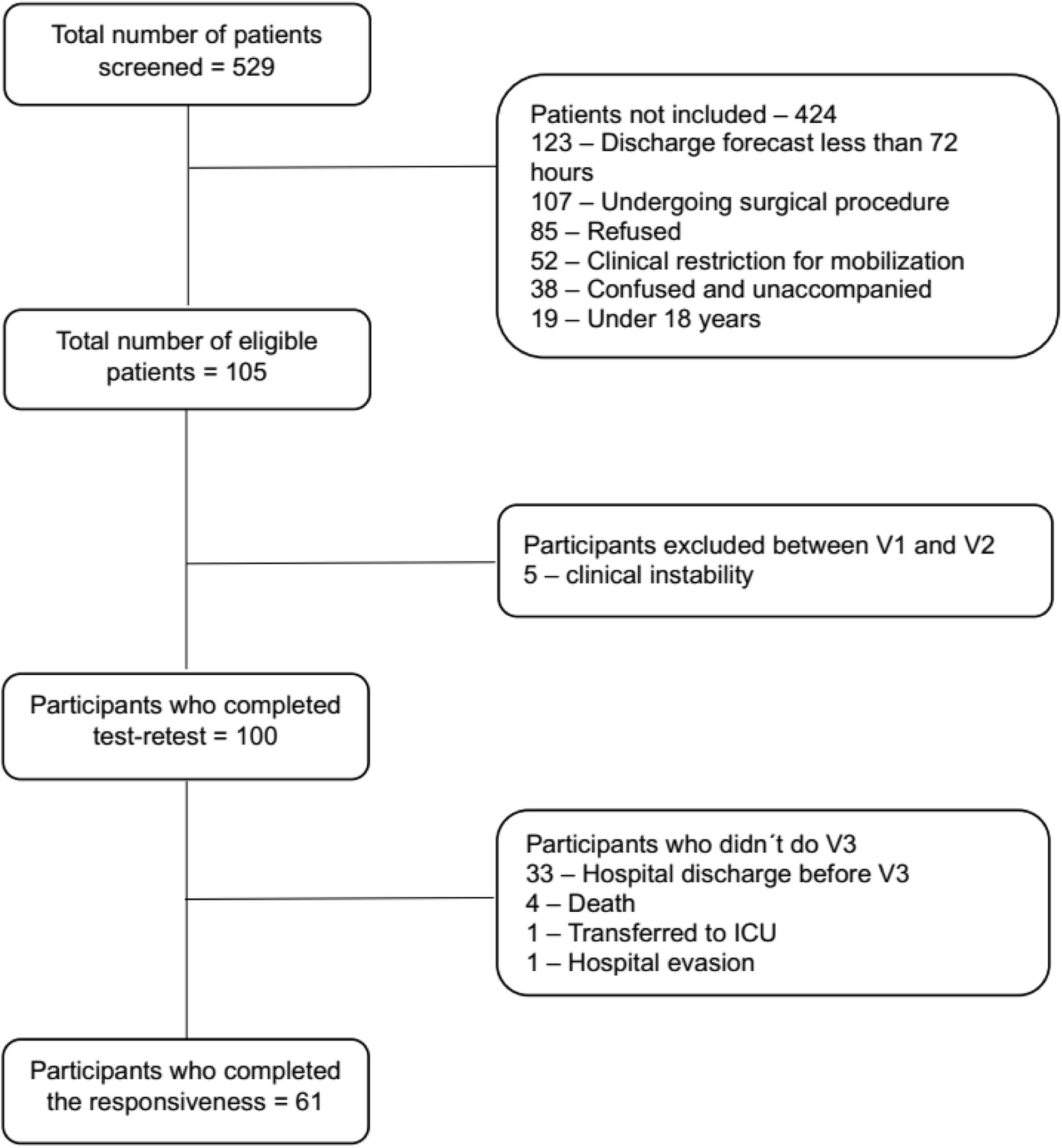
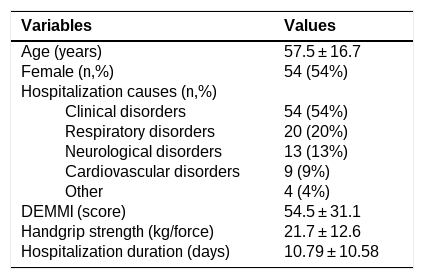
ResultsThis study was conducted from July 2024 to March 2025, when the sample size was reached. Assessments were conducted by three physical therapists with an average of ten years of experience. The screening flowchart and the reasons for non-inclusion or exclusion of patients are available in Fig. 1, and the descriptive characteristics of the included participants are available in Table 1.
Basal characteristics of study participants (n = 100).
DEMMI – De Morton Mobility Index; Kg=kilogram. Data are presented as mean ± standard deviation or Absolute number (percentagem).
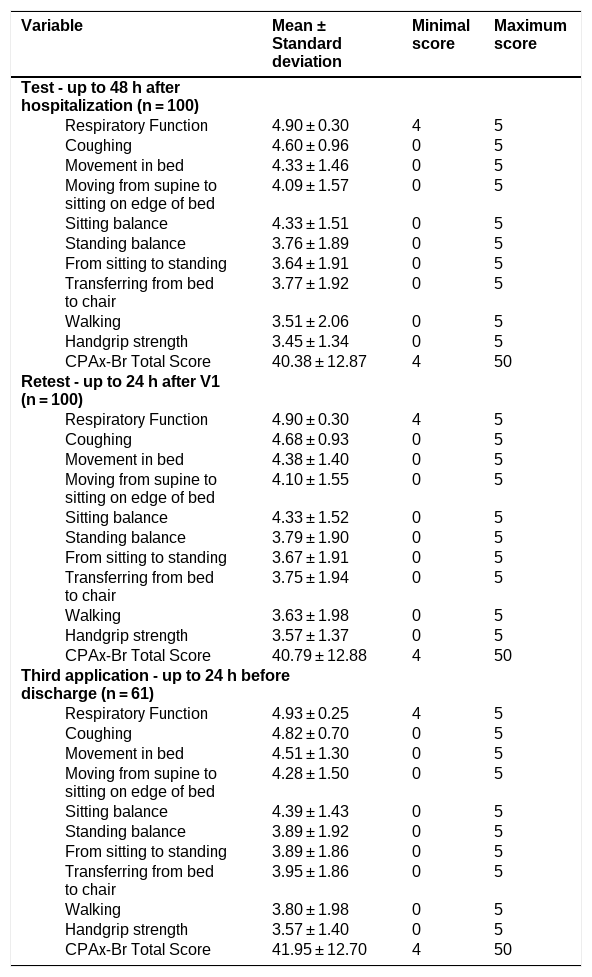
The scores obtained in the CPAx-Br assessment for each of the three assessments are shown in Table 2. There was no missing data from patients who completed one of the study's stages.
CPAx-Br scores from the three assessments performed.
CPAx-Br – Brazilian version of the Chelsea Critical Care Physical Assessment Tool; V1 – Baseline Assessment.
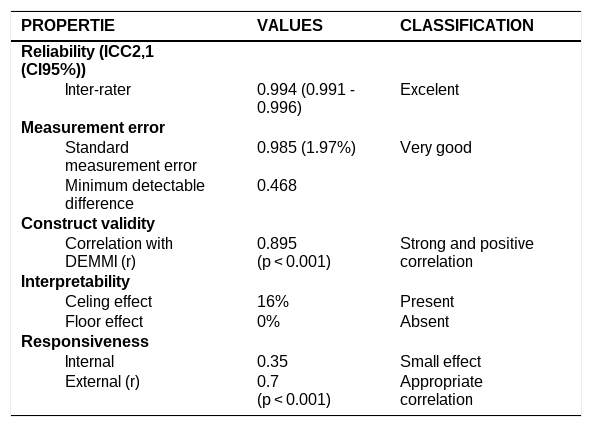
Inter-rater reliability and measurement error were considered acceptable according to predefined criteria. For construct validity (hypothesis testing), the normality analysis indicated a non-normal distribution of the data; therefore, Spearman's correlation with the DEMMI scale was used, and the results indicated a positive correlation. In the interpretability analysis, the floor effect was absent, and the ceiling effect was present. Internal responsiveness demonstrated a small but present effect size. For External Responsiveness, data analysis showed a normal distribution, and Pearson's correlation between the CPAx-BR score variation (V3-V1) and the DEMMI score variation (V3-V1) indicated a positive and appropriate correlation between the instruments (Table 3).
Classification of CPAx-Br measurements properties in adults hospitalized in a ward.
ICC – Intraclass correlation coeficiente; CI – Confidence interval; DEMMI – De Morton Mobility Index; r – Correlation coeficiente. Mokink et al., 201017.
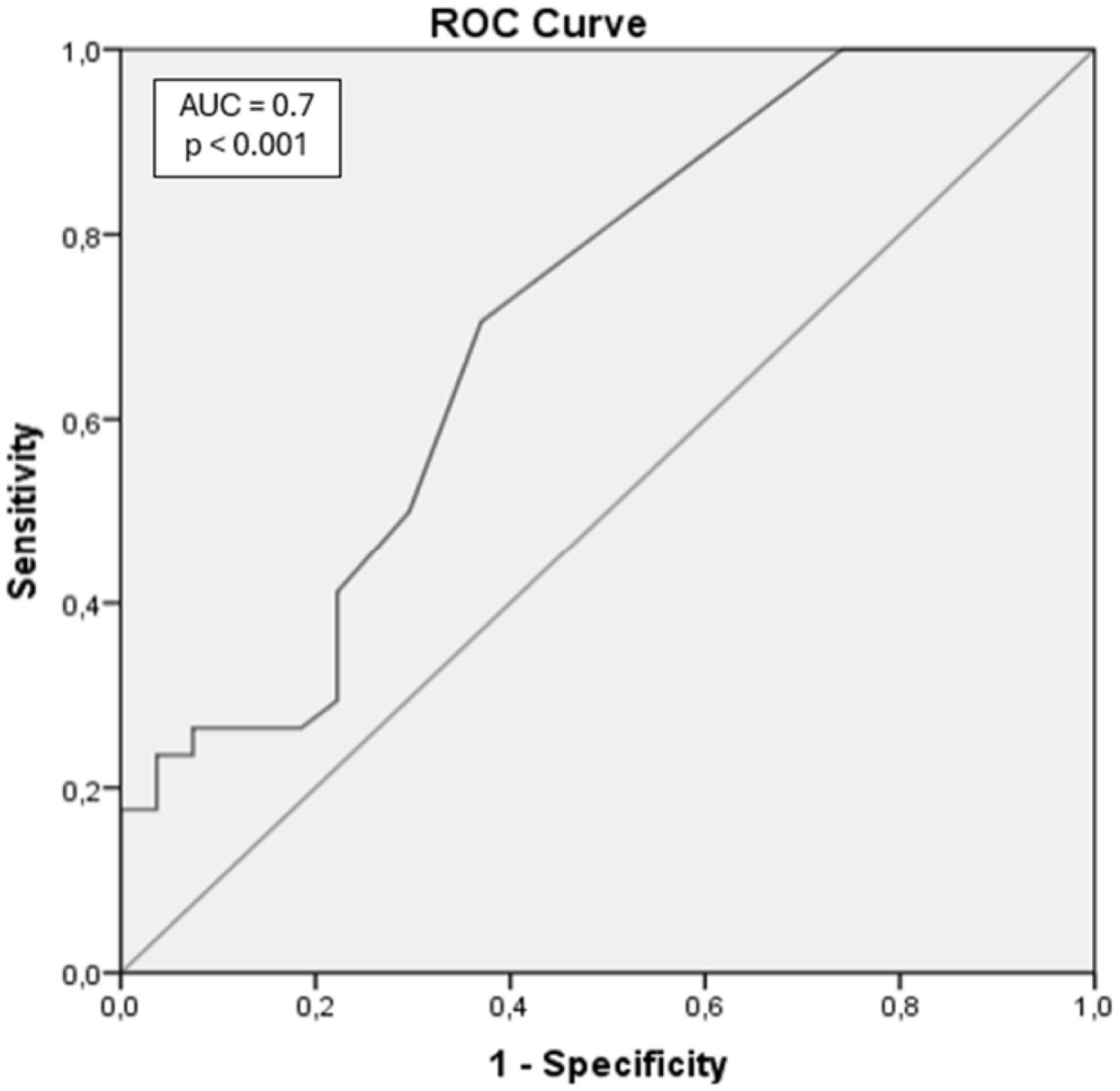
Regarding the subjective perception of clinical change, 63% of participants who completed the questionnaire (n = 54) at hospital discharge reported improved mobility, 31% reported no change, and 6% reported worsening. Using this self-assessment as an external reference, ROC curve analysis showed that CPAx-Br demonstrated an acceptable ability to detect clinical change over time, with an AUC of 0.7 (95% CI 0.54 to 0.85) (Fig. 2).
DiscussionThis study evaluated the measurement properties of the Brazilian Portuguese version of the Chelsea Intensive Care Physical Rating Scale (CPAx-Br) applied to patients hospitalized in general wards. The results provide evidence of validity based on hypothesis testing, as well as good reliability and moderate responsiveness of the CPAx-Br for assessing physical function in hospitalized adult patients, although it may be less sensitive in those with minimal physical impairments.
Currently, the only validated instrument in Brazilian Portuguese for specific use in hospital wards is the De Morton Mobility Index (DEMMI).22 which, although robust, is limited to the elderly and focuses primarily on mobility and balance. In contrast, most available tools were developed for ICU populations, where functional impairments such as ICU-acquired weakness are already well documented and associated with long-term consequences.34 However, patients in general wards are also at risk of functional deterioration during hospitalization, highlighting the need for accurate assessment instruments in this clinical context.35
Against this backdrop, we analyzed the measurement properties of the CPAx-Br in patients hospitalized in general wards. Notably, this is the first study to assess the measurement properties of CPAx in this specific patient population. In our findings, CPAx-Br demonstrated excellent inter-rater reliability, consistent with previous studies on other language versions.6,11–13,36 This reflects the instrument’s robustness in yielding similar results across different raters and time points. SEM was very good, and MDD was 0.468 points, indicating that score variations above this threshold likely reflect true clinical changes. These findings suggest that CPAx-Br is sensitive to subtle functional changes in hospitalized ward patients.
Hypothesis testing for construct validity was conducted by assessing correlations with the DEMMI. Despite some unique items in each scale, both instruments share similar domains. As hypothesized, we observed a strong positive correlation, providing evidence of construct validity for the CPAx-Br in this context. Among the few studies that have assessed construct validity of the CPAx.6,12 this study reported the highest correlation to date.
The responsiveness of CPAx had been analyzed only once before by Astrup et al.37 who followed 24 ICU patients transitioning to the ward and reported a large effect size.37,38 In our study, responsiveness was evaluated in 61 patients, a sample size considered very good by COSMIN standards.39 Internal responsiveness was classified as small, suggesting limited sensitivity to detect functional changes over time. This may be due to the low-complexity hospital setting, the relatively younger and less frail patient population (mean age 57), and high baseline functional scores (mean CPAx-Br ≈ 40), which reduced the potential for change during hospitalization (mean length of stay: ∼11 days). These factors likely contributed to the ceiling effect and limited internal score variability.
Conversely, external responsiveness showed acceptable results. Changes in CPAx-Br scores were associated with changes in the external measure, providing acceptable evidence that the instrument can detect changes over time. Furthermore, the association between changes in CPAx-Br scores and patients' perceived improvement provided evidence that the instrument may reflect clinically relevant changes from patients’ perspectives.40,41 However, these findings should be interpreted with caution, particularly given the uncertainty of the ROC analysis, as reflected by the relatively wide confidence interval around the AUC estimate.
ConclusionsThe findings of this study provide evidence of validity based on hypothesis testing, as well as good reliability and acceptable external responsiveness of the CPAx-Br for assessing physical function in adult hospitalized patients. The results are promising and suggest the scale's applicability in the Brazilian context; however, caution is warranted when generalizing these findings. Further studies in different patient profiles and clinical settings are needed to strengthen the evidence on the scale's measurement properties, particularly responsiveness, and to confirm its practical utility across diverse hospital physical therapy settings.
FundingLucci A. received a graduate research scholarship from Coordination of Superior Level Staff Improvement (CAPES).
The author(s) declared no potential conflicts of interest.
Received 26 August 2025; Received in revised form 25 August 2026; Accepted 22 September 2026.