

Inadequate resolution of inflammation following ankle sprain may contribute to persistent pain and chronic instability. However, the effectiveness of active interventions, such as ankle pump exercises, during the acute phase remains uncertain.
ObjectiveTo investigate whether ankle pump exercises provide additional benefit when added to usual care in the management of acute ankle sprain.
MethodsThis randomised controlled trial included 88 individuals with acute ankle sprain. Both groups received usual care based on the protection, optimal load, ice, compression, and elevation protocol. Participants in the experimental group additionally performed ankle pump exercises. Primary outcomes were oedema, assessed using the figure-of-eight ankle perimetry method; pain, assessed using a visual analog scale; and function, assessed using the Foot and Ankle Ability Measure (daily living and sports subscales). Outcomes were assessed at baseline, 5 days post-intervention, and 15 days post-intervention.
ResultsAfter 5 days of intervention, the experimental group demonstrated a greater reduction in ankle oedema than the control group (mean difference −1.2 cm, 95% CI −2.2; −0.2). This between-group difference was not evident at 15-day follow-up (mean difference −0.9 cm, 95% CI −1.9; 0.1). No between-group differences were observed for pain, ankle range of motion, or function at any time point.
ConclusionOur findings indicate that adding ankle pump exercises to usual care produced a statistically significant but small short-term reduction in oedema compared to usual care alone, unlikely to be clinically meaningful. No benefits were observed in pain, mobility, or function, and no between-group differences were observed at the 15-day follow-up.
Ankle sprains are among the most prevalent musculoskeletal injuries.1 Clinical features in the acute phase include oedema, pain, and functional limitation.1,2 In some individuals, the inflammatory response persists beyond the acute stage, which may contribute to tissue sensitisation and an increased risk of chronic pain.3 Consistent with this, approximately 7% of people who sustain an ankle sprain report residual pain one year after injury.4 Appropriate early management is therefore essential, given the risk of progression to chronic ankle instability5 and the potential long-term development of ankle osteoarthritis.6
Early management following an acute ankle sprain aims to control inflammatory signs in order to optimise tissue healing.7–9 However, there is limited standardisation in clinical practice for this purpose.8,10 Pharmacological management with non-steroidal anti-inflammatory drugs has been advocated in some studies,11,12 but their use may interfere with physiological healing processes.13 Emerging evidence suggests that conservative, non-pharmacological interventions may achieve comparable symptom control without these potential adverse effects.13 Protocols incorporating protection, load management, and symptom-relieving strategies such as cryotherapy are commonly used in the management of acute ankle sprain.11,13 Nevertheless, due to joint dysfunction and movement restriction, these protocols, typically adopted as usual care, may be insufficient to restore function and joint stability in some individuals.8,13 Consequently, active, exercise-based interventions may be preferred over exclusively passive strategies,14 although uncertainty remains regarding their effectiveness during the acute phase.8,13
Oedema is a particularly relevant clinical feature, as it is associated with reduced ankle range of motion (ROM).15 Restricted dorsiflexion has been identified as one of several factors potentially associated with recurrent ankle sprain,16 and consequently, the development of chronic ankle instability.5 Thus, interventions that effectively reduce oedema may facilitate recovery of ROM and functional performance.17 Ankle pump exercises, comprising low-intensity, repetitive active ankle movements performed with limb elevation, have been proposed as a potential strategy to enhance fluid clearance.18 This approach has demonstrated beneficial effects on lower limb fluid dynamics in other clinical contexts.19–21 In acute ankle sprain, Bleakley et al17 incorporated similar active exercises, without limb elevation, and reported improvements in function. In the study by Qi-Ning et al.,22 ankle pump exercises were included in both experimental and control interventions, precluding conclusions regarding their independent effect. Taken together, current evidence is insufficient to determine the effectiveness of ankle pump exercises in the management of acute ankle sprain. Therefore, the study aim was to investigate whether the addition of ankle pump exercises to a usual care protocol provides additional benefits in reducing oedema and pain following acute ankle sprain.
MethodsDesignThis was a randomised controlled trial with concealed allocation, a two-arm parallel-group design, blinded outcome assessors, and analysis conducted according to the intention-to-treat principle. Participants were randomly allocated to either an experimental group or a control group. An independent researcher not involved in participant recruitment, assessment, intervention delivery, or data analysis generated the random allocation sequence using the RAND function in Microsoft Excel, with a 1:1 allocation ratio and no stratification or blocking. Group assignments were placed in sequentially numbered, opaque, sealed envelopes prepared before participant recruitment. After confirmation of eligibility screening and completion of baseline assessments, the next envelope in sequence was opened to reveal group allocation. To maintain assessor blinding, all post-intervention assessments were conducted by an independent researcher who was not involved in participant recruitment, allocation procedures, baseline assessments, or intervention delivery. Due to the nature of the interventions, participants and therapists could not be blinded to group allocation. Data collection was conducted between March 2024 and November 2025. The study was reported in accordance with the CONSORT statement.23 Ethical approval was obtained from the Federal University of Santa Maria Human Research Ethics Committee (Registration No CAAE 70,793,223.2.0000.5346). All participants gave written informed consent before data collection began. This study was registered in the Brazilian Registry of Clinical Trials (RBR-10 g7v5bx) in August 2023.
Deviation from protocolAdverse events and medication use were collected during follow-up to obtain additional clinical and safety information; however, these variables were not prespecified outcomes in the trial registration.
ParticipantsEighty-eight individuals with acute ankle sprain participated. Eligible participants were males and females aged over 15 years who reported an ankle sprain, regardless of injury grade, occurring within 96 h prior to allocation and who presented visible oedema attributable to the injury.24,25 Exclusion criteria were: (i) fracture in the affected ankle region; (ii) oedema of systemic or hormonal origin, including that related to cardiac or renal conditions or pregnancy; (iii) use of a plaster cast that could not be removed to allow application of the interventions; and (iv) self-reported neurological, musculoskeletal, cardiovascular, pulmonary, or metabolic conditions that could interfere with or contraindicate the study procedures.25 Participants were recruited via institutional email lists from the university, social media advertisements, and direct referral from an emergency care unit at a public hospital. All participants provided written informed consent prior to enrolment.
ProceduresAt the baseline assessment, participants were assessed for sample characterisation and baseline values of the outcomes of interest. Participants were then randomised to one of the intervention protocols, which were delivered over a five-day period. Following completion of the intervention period, participants returned for the first post-intervention assessment, which included assessment of pain intensity, ankle perimetry, ankle ROM, and function. Ten days after the end of the intervention period, a second follow-up assessment was conducted, during which the same outcomes were reassessed. All assessments were performed at the Department of Physiotherapy and Rehabilitation (Federal University of Santa Maria).
InterventionBoth groups received usual care based on the Protection, Optimal Load, Ice, Compression and Elevation (POLICE) protocol12 (Supplementary Material 1A). This protocol is commonly recommended for the management of acute ankle sprain and aims to limit excessive inflammation while preserving function.11,13,17
- Protection and Optimal Load: Participants were instructed to reduce or modify daily activities that could place excessive stress on the injured ankle, or to perform such activities with caution.12 Participants were also instructed to refrain from sports or other physical activities that could put the ankle at risk during the intervention period. No orthoses or braces were prescribed as part of the study; however, if such devices had been prescribed during emergency care prior to enrolment, their use was not modified.
- Ice, Compression and Elevation: Participants were instructed to apply ice to the injured ankle three times per day for five consecutive days. Cryotherapy was delivered using crushed ice placed in a plastic bag and secured over the ankle with a bandage to provide light compression.17 Ice was applied for 10 min, followed by a 10-minute interval without ice, and then reapplied for a further 10 min.17,26 During cryotherapy, the limb was positioned in elevation, with approximately 30–45° of hip flexion. Compression was intended to mechanically limit haematoma expansion, while limb elevation was used to reduce local hydrostatic pressure and fluid accumulation at the injury site.11,13 Participants were provided with plastic bags and bandages to facilitate compression cryotherapy.
Both groups received a support booklet containing written instructions and illustrative images of the usual care procedures, as well as access to a video tutorial (Supplementary Material 2). In addition to usual care, participants allocated to the experimental group were instructed to perform ankle pump exercises (Supplementary Material 1B).
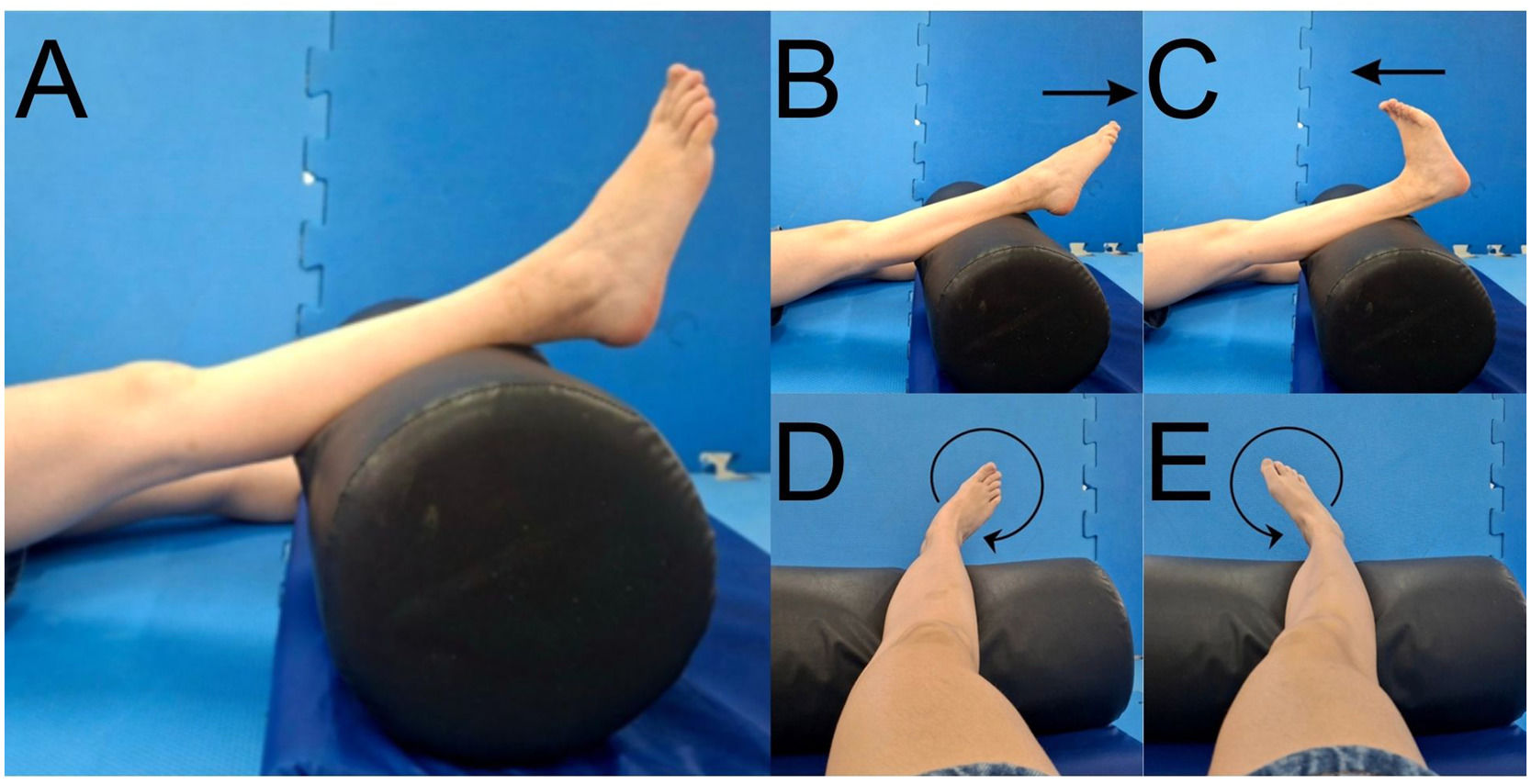
- Ankle Pump Exercises: Participants performed ankle pump exercises three times per day, at times separate from cryotherapy sessions, for five consecutive days. Exercises were performed in a supine position with the injured limb elevated to approximately 30–45° of hip flexion (Fig. 1A). Participants performed continuous, active plantarflexion and dorsiflexion movements for five minutes (Fig. 1B and 1C), followed by five minutes of ankle circumduction, alternating between clockwise and counterclockwise directions (Fig. 1D and 1E). Movements were performed through the maximum pain-free range of motion, and participants were instructed to gradually increase movement speed over the intervention period, provided pain did not worsen. Participants received a video tutorial demonstrating the ankle pump exercises.
To promote adherence in both groups, standardised daily reminders were sent via WhatsApp during the five-day intervention period. These messages included demonstration videos (Supplementary Material 3) and written guidance reinforcing correct performance of the assigned interventions.
Outcome measuresPrimary outcomes- Oedema: it was assessed using the figure-of-eight ankle perimetry method.7,27 Participants were positioned supine with the ankle in a neutral position. A tape measure was placed over the tibialis anterior tendon between the malleoli and passed sequentially over the navicular tuberosity, the base of the fifth metatarsal, the medial malleolus, the Achilles tendon, and the lateral malleolus, returning to the starting point.25,28 Three measurements were obtained, and the mean value was used for analysis. This method demonstrated adequate inter-rater reliability (Supplementary Material 4).
- Pain Intensity: it was measured using a 10-cm visual analog scale (VAS), on which participants indicated their current level of pain, anchored by “no pain” and “worst imaginable pain”.29
- Function: it was assessed using the Foot and Ankle Ability Measure (FAAM), which is composed of two subscales.30 The questionnaire comprises 21 items related to activities of daily living and eight items related to sports activities. Each item is scored on a 5-point Likert scale based on perceived difficulty performing specific tasks, ranging from “no difficulty” (4 points) to “unable to do” (0 points). Items not applicable to the participant were excluded from the total score. Scores for both subscales were converted to percentages, with higher values indicating better ankle-related function.30
Secondary outcomesAnkle ROM was measured using a digital inclinometer positioned 10 cm below the tibial tuberosity. For each movement, three measurements were recorded and the mean value was used for analysis. Inter-rater reliability for these measurements was adequate (Supplementary Material 4).
- Dorsiflexion ROM: it was assessed in standing using the weight-bearing lunge test.31,32 Participants adopted a lunge position and performed maximal ankle dorsiflexion while maintaining heel contact with the floor. In this position, the inclinometer measured the tibial inclination angle.33
- Plantarflexion ROM: it was assessed with participants in the supine position, with the knee of the tested limb flexed and the plantar surface of the foot in contact with the treatment table. Participants were instructed to slide the foot forward while extending the knee, maintaining contact between the heel and the metatarsophalangeal joints and the table. The movement was stopped when the head of the fifth metatarsal lost contact with the surface, and the angle between the tibial axis and the vertical was measured using the inclinometer.34
Adverse events and medication use were recorded throughout the study period.
Of note, outcome assessors responsible for objective measurements (oedema and ROM) were blinded to group allocation. Patient-reported outcomes (pain and function) were inherently completed by participants who were aware of their allocated intervention.
Data analysisSample size calculation was performed for all primary outcomes (oedema, pain, and function), and the largest estimated sample size was adopted to ensure adequate statistical power across outcomes. The calculation was based on findings from previous studies reporting between-group differences for the primary outcomes, corresponding standard deviations, assuming 80% statistical power, a two-sided alpha level of 0.05, and an anticipated loss to follow-up of 15%. Specifically, for oedema, a between-group difference of 4 cm in figure-of-eight perimetry35 with a standard deviation of 6 cm28 indicated a minimum sample of 42 participants. For pain, a between-group difference of 2 cm on the VAS36,37 with a standard deviation of 2.5 cm17 indicated a minimum of 29 participants per group. For function, between-group differences of 12% for the activities of daily living subscale and 13% for the sports subscale,36,38 with standard deviations of 13% and 9%,36 indicated minimum sample sizes of 22 and 10 participants per group, respectively. Sample size calculations were performed using G*Power software.
Missing data were handled using multiple imputation.39 Twenty imputed datasets were generated using baseline characteristics and outcome data from all assessment time points as predictors. Imputed datasets were pooled by calculating mean estimates for analysis.40,41
All analyses were conducted according to the intention-to-treat (ITT) principle, preserving original group allocation. Secondary analyses included a sensitivity analysis based on ankle sprain type.
Intervention effects were analysed using linear mixed-effects models, with baseline values included as covariates, to compare experimental and control groups across assessment time points. Mean between-group differences and corresponding 95% confidence intervals were calculated for each outcome. When statistically significant effects were identified, post hoc comparisons were adjusted using the Bonferroni correction. Statistical significance was set at p ≤ 0.05. All analyses were performed using IBM SPSS Statistics (version 26).
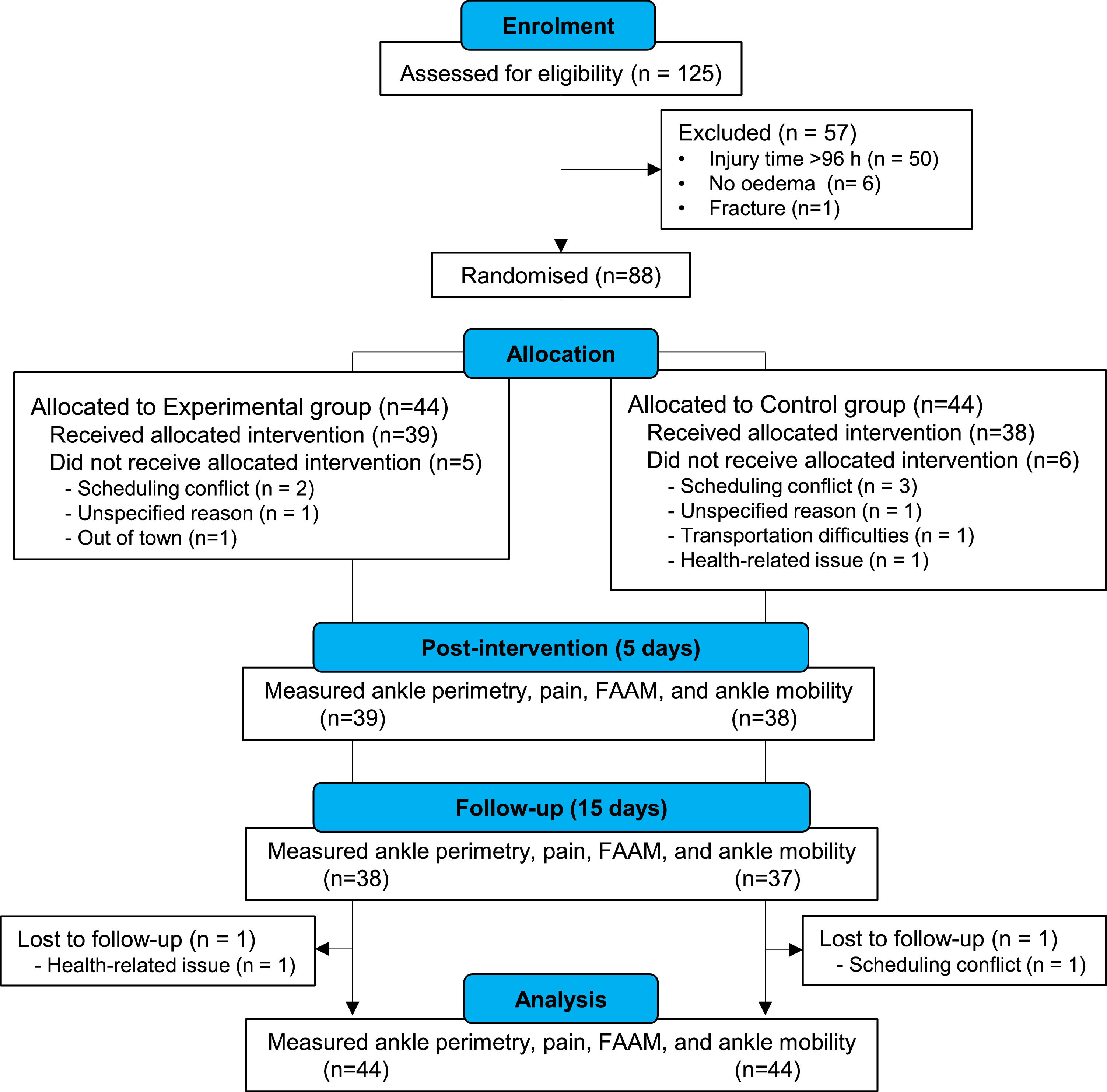
ResultsFlow of participants through the studyOf the 88 participants randomised, 11 did not return for the post-intervention assessment and two did not attend the final follow-up assessment, resulting in a total loss to follow-up of 13 participants (14.8%) (Fig. 2). The majority of losses were due to reasons unrelated to the study procedures.
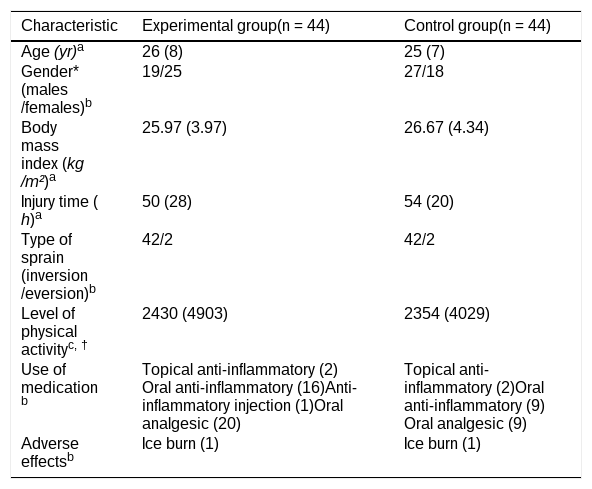
Baseline characteristics were comparable between groups with respect to injury duration, age, sex, demographic and anthropometric variables, physical activity level (Table 1), and outcomes of interest.
Characteristics of participants.
| Characteristic | Experimental group(n = 44) | Control group(n = 44) |
|---|---|---|
| Age (yr)a | 26 (8) | 25 (7) |
| Gender* (males/females)b | 19/25 | 27/18 |
| Body mass index (kg/m²)a | 25.97 (3.97) | 26.67 (4.34) |
| Injury time (h)a | 50 (28) | 54 (20) |
| Type of sprain (inversion/eversion)b | 42/2 | 42/2 |
| Level of physical activityc, † | 2430 (4903) | 2354 (4029) |
| Use of medicationb | Topical anti-inflammatory (2)Oral anti-inflammatory (16)Anti-inflammatory injection (1)Oral analgesic (20) | Topical anti-inflammatory (2)Oral anti-inflammatory (9) Oral analgesic (9) |
| Adverse effectsb | Ice burn (1) | Ice burn (1) |
Outcome assessors were blinded to group allocation throughout the study. All participants received their allocated intervention and were analysed according to the intention-to-treat principle. One ineligible participant was randomised and later diagnosed with a fracture; their data were retained in the primary analysis. Excluding this participant in a sensitivity analysis did not materially change the results (Supplementary Material 5).
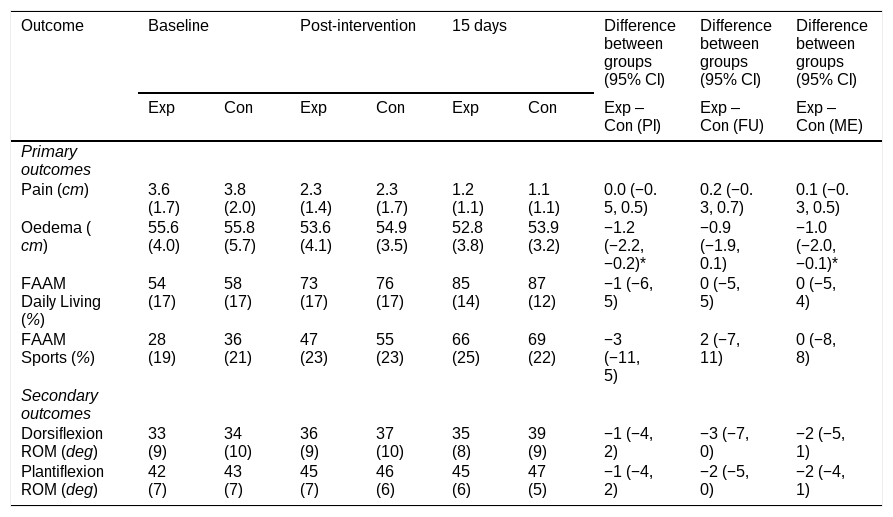
Effect of interventionsDescriptive statistics for all outcomes at each assessment time point are presented in Table 2. Individual data are reported in Supplementary Material 6. After five days of intervention, a statistically significant between-group difference was observed for oedema, favouring the experimental group (mean difference −1.2 cm, 95% CI −2.2; −0.2). However, this difference was no longer evident at follow-up (mean difference −0.9 cm, 95% CI −1.9; 0.1).
Mean (SD) of groups, and mean differences (95% CI).
Abbreviations: Con, control group; Deg, degrees; Exp, experimental group; FU, follow-up mean differences using baseline as covariate; ME, main effect for groups using baseline as covariate; PI, post-intervention mean differences using baseline as covariate; ROM, range of motion.
*Significant difference.
No statistically significant between-group differences were observed for pain intensity, ankle ROM, or function at either the post-intervention assessment or follow-up (Table 2).
Additional clinical informationReports of medication use and adverse events during the study period are presented in Table 1. The experimental group reported a higher frequency of medication use than the control group, while adverse events were minimal and similar between groups.
DiscussionOur findings indicate that adding ankle pump exercises to usual care resulted in a statistically significant reduction in ankle oedema after five days of treatment compared with usual care alone. However, the magnitude of this difference was small and unlikely to be clinically meaningful, as reflected in the confidence interval that approached the null effect. Furthermore, the addition of ankle pump exercises did not influence pain intensity, functional outcomes, or ankle mobility at the post-intervention assessment. No between-group differences were observed for any outcome at the 15-day follow-up.
Previous studies have demonstrated that ankle pump exercises can enhance venous return and regional blood flow.19,21 However, this evidence largely relates to haemodynamic impairments rather than acute inflammatory conditions. In acute ankle sprain, oedema formation is primarily driven by inflammatory exudate rather than venous stasis. Although the muscle pump mechanism activated during ankle pump exercises may assist in fluid mobilisation, its effect on oedema appears minimal and insufficient to meaningfully facilitate inflammatory fluid clearance during the acute phase, in which exudate production is ongoing. This mechanism likely explains the limited clinical benefit observed with the addition of ankle pump exercises in the management of acute ankle sprain.
Oedema contributes to tissue sensitivity and may influence pain perception following ankle injury.43 Nevertheless, the magnitude of oedema reduction observed in this study was insufficient to translate into perceptible changes in pain intensity. Pain-related motor adaptations, such as guarded movement and avoidance behaviours, may also have constrained voluntary movement during both the intervention and outcome assessments.44 As participants were instructed to perform the exercises within pain-free limits, movement amplitude and speed were likely restricted, thereby limiting the neuromuscular stimulus. In addition, cryotherapy induces local vasoconstriction, reduces nerve conduction velocity, and increases pain thresholds in free nerve endings.10 Consequently, usual care alone may have been sufficient for pain control, which would explain the absence of between-group differences in pain outcomes. The lack of additional analgesic benefit further supports the limited clinical relevance of ankle pump exercises in this context.
Restricted ankle mobility following sprain is influenced mechanically by inflammatory fluid accumulation, which reduces available joint space for movement.45 Therefore, the modest and transient reduction in oedema observed in this study is likely insufficient to affect ankle mobility. Additionally, ankle movement may be further compromised by reflex inhibition of the surrounding musculature, commonly referred to as arthrogenic or iatrogenic muscle inhibition.46 Early exercise interventions aim to promote muscle activation and preserve mobility following injury.47,48 However, this effect was not observed with the low-intensity muscle contractions elicited by ankle pump exercises in the present study. These findings raise questions about the appropriate intensity and specificity of exercise during the acute management of ankle sprain, particularly given the lack of functional improvement.
Evidence from Bleakley et al17 suggests that accelerated rehabilitation introduced during the first two weeks following ankle sprain can improve functional outcomes compared with standard care emphasising rest, despite no additional benefits for oedema or pain. Notably, their intervention incorporated a more comprehensive exercise programme, including isometric strengthening, functional movement patterns, and triceps surae stretching, in addition to movements resembling ankle pump exercises performed without limb elevation. This comparison suggests that the effectiveness of therapeutic exercise in the acute phase of ankle sprain may depend on exercise intensity, progression, and task specificity rather than isolated muscle pump activity. Therefore, the present findings should not be interpreted as evidence against early exercise following acute ankle sprain, but rather as evidence that the isolated addition of ankle pump exercises provides limited benefit beyond usual care. Further research is warranted to determine the optimal type, intensity, and progression of exercise during the acute phase of ankle sprain, as well as the contribution of individual exercise components within comprehensive rehabilitation programmes.
Clinical implicationsAlthough a statistically significant reduction in ankle oedema was observed, the between-group difference at five days was limited (1.2 cm in figure-of-eight perimetry). Although no established minimal clinically important difference has been reported for oedema measured using figure-of-eight perimetry,49 the absence of between-group differences for pain, function, and ankle mobility suggests that the observed reduction in oedema was insufficient to produce benefits in outcomes that are directly relevant to patients and clinicians. Furthermore, between-group differences in pain and function were negligible, and the observed 2-degree difference in ankle ROM did not exceed the minimal detectable change reported for the assessment method.31
Therefore, clinicians managing acute ankle sprain should prioritise established usual care strategies, such as protection, optimal loading, cryotherapy, compression, and elevation. The addition of ankle pump exercises, while unlikely to cause harm, is unlikely to provide meaningful short-term clinical benefits beyond usual care. When exercise is introduced during the acute phase, greater emphasis may be placed on interventions that provide sufficient neuromuscular stimulus and functional relevance, rather than low-intensity, isolated movements. These findings underscore the importance of selecting exercise interventions based on demonstrated clinical effectiveness rather than theoretical physiological rationale alone.
Study limitationsDespite its robust methodological design, including assessor blinding, randomisation, and intention-to-treat analysis, several limitations should be acknowledged. The interventions were delivered without direct supervision, which may have influenced exercise adherence. Although adherence was reinforced through daily electronic reminders and instructional materials, adherence was not directly monitored, and participants may not have completed the prescribed exercise volume. Nevertheless, this limitation is inherent to many unsupervised interventions, and current evidence does not conclusively support the superiority of supervised over unsupervised ankle rehabilitation programmes.8,13 Loss to follow-up occurred but remained below 15%, which is generally considered acceptable for clinical trials. One participant who was later diagnosed with a fracture was retained in the primary analysis in accordance with the intention-to-treat principle; sensitivity analyses confirmed that inclusion of this participant did not influence the findings. Accordingly, variability in participant characteristics, including age and ankle sprain severity, may have contributed to heterogeneity in treatment responses. However, the study was designed with pragmatic eligibility criteria to enhance external validity and reflect the diversity of patients commonly encountered in clinical practice. Finally, medication use was more frequent in the experimental group. Although no impact on pain outcomes was observed, it cannot be ruled out that this imbalance may have contributed, at least in part, to the small between-group difference observed for oedema.
ConclusionsIn summary, our trial demonstrated that adding ankle pump exercises to a usual care protocol resulted in a small, short-term reduction in ankle oedema following acute ankle sprain compared with usual care alone. However, this effect was not clinically meaningful and did not translate into improvements in pain, ankle mobility, or function. No additional benefits were observed at the 15-day follow-up.
FundingThis work was supported under public notices 010/2024 (PIBIC/CNPq/UFSM and PROBIC/FAPERGS/UFSM; scholarship to Bruna Da Cas and Andreza de Lima).
The author(s) declared no potential conflicts of interest.
The authors would like to thank the Federal University of Santa Maria (UFSM), the National Council for Scientific and Technological Development (CNPq), and the Rio Grande do Sul Research Foundation (FAPERGS) for the financial support.